Pokies Casinos in New Zealand: Rules and Real-Money Play
 Available in US
A clear look at real-money and free pokies, changing oversight, and the differences between game types and bonus offers.
Table of Contents
- Pokies Casinos in New Zealand as the Rules Change
- Real-Money Play at Online Casinos
- Free Pokies, Random Spins and the Meaning of a Review
- New Online Casinos and the Limits of Offshore Oversight
- Searching for “The Pokies” Online
- What Makes One Pokies Game Different from Another
- From Three Reels to Video Pokies
- Jackpots, Crash Games and Bonus-Buy Rounds
- Promo Codes and the Cost of Bonus Conditions
- Real Online Pokies and the Limits of Local Protection
Pokies Casinos in New Zealand as the Rules Change
New Zealand’s online casino market in 2026 sits between two different ideas of legality. A casino cannot be based and operated inside the country under the Gambling Act 2003. Yet the law has not treated an individual’s decision to use an overseas website as the same offence. That distinction shaped the market for years: local operation was prohibited, while online services reached New Zealand from elsewhere.
The distinction is more than a technicality. It separates the place where a gambling business is established from the place where its customers happen to live. New Zealand’s rules historically drew a firm line around domestic online casinos without building a local licensing system for offshore providers. The result was a market used by local players but not supervised as a domestic casino industry.
That arrangement is now changing. The Online Casino Gambling Act 2026 created New Zealand’s first domestic licensing framework for online casino gambling. The Act took effect on 1 May 2026, but the new system is not a switch that instantly turns every existing service into a licensed one. Instead, a transition period runs from that date to 1 December 2026. Providers already offering services in New Zealand before the Act began may continue during that window, under its transitional provisions.
Choosing a pokies casino in New Zealand means weighing the details that are available for each operator. This guide offers a concise reference to help you assess the listed options.
Payout speed: 1-3 business days Wintino lists a payout speed of 1–3 business days, a useful detail for players considering withdrawal timing.
License: Curaçao Gaming Authority, licence no. OGL/2024/165/0185 BitStarz lists a Curaçao Gaming Authority licence, number OGL/2024/165/0185.
License: Malta Gaming Authority, licence no. MGA/B2C/370/2017 Play Grand lists a Malta Gaming Authority licence, number MGA/B2C/370/2017.
License: Tobique Gaming Commission, licence no. 0000091 7Bit Casino lists a Tobique Gaming Commission licence, number 0000091.
License: Tobique Gaming Commission, licence no. 0000064 Neospin lists a Tobique Gaming Commission licence, number 0000064.
License: Tobique Gaming Commission, licence no. 0000002 Ricky Casino lists a Tobique Gaming Commission licence, number 0000002.
License: 07017519840 · Payout speed: 1-3 business days Zotabet lists licence number 07017519840 and a payout speed of 1–3 business days.
Payout speed: 1-3 business days Lamabet lists a payout speed of 1–3 business days, giving readers a stated timeframe to consider.
License: Malta Gaming Authority, licence no. MGA/B2C/394/2017 N1 Casino lists a Malta Gaming Authority licence, number MGA/B2C/394/2017.
The full licensing regime is not expected to be operational until 2027. That timing matters when describing the market in 2026: a new legal framework exists, while the finished system of licensed online casinos is still ahead. Unlicensed operation is expected to become an offence around the middle of 2027. The legal landscape is therefore moving in stages, rather than replacing the old arrangement in a single moment.
A specialist review had described the planned rollout as beginning in 2026 and the initial framework as making provision for up to 15 licences. Those details belong to an earlier view of the plan, not a reason to treat the licensing market as already settled. The legislation’s transition dates and the later expected start of the full regime give a more precise picture of what 2026 means in practice.
The Department of Internal Affairs is the regulator named under the licensing framework. Licensed operators are expected to meet requirements covering harm minimisation, advertising, age checks and tax contributions. These are not decorative obligations. They define what it would mean for an online casino to operate within New Zealand’s new domestic system, rather than simply make its services available from abroad.

For the country, this is a notable shift in the object of regulation. The older prohibition concerned where an online casino could be based: not in New Zealand. The new framework addresses which providers may serve the market under domestic oversight. It does not erase the distinction between an operator established locally and one operating from overseas; it introduces a route to licensing and supervision that did not previously exist.
That change also helps explain why phrases such as “New Zealand casino” can blur unlike situations. A website may be accessible to people in New Zealand without being a New Zealand-based business, and accessibility alone does not establish that it holds a domestic licence. During the transition, the legal position depends in part on whether a provider was already operating in the market before the Act’s commencement and on the provisions governing that period.
The name of the game has long been local; the location of the business often has not. That gap is what the new system is designed to address. It brings online casino provision into a domestic licensing framework while preserving the prohibition on establishing an online casino within New Zealand under the older Act. Regulation, in other words, is not the same as permission to base the casino here.
For anyone assessing the best online pokies casinos available to New Zealand players in 2026, the year itself is part of the context. The country has passed the legislation, begun the transition and set out a path toward a fully operating licensing regime. But the transition is not the finished market. A label suggesting domestic regulation should therefore be read in light of the provider’s status and the stage of implementation, not taken as a general description of every site reachable from New Zealand.
Licensing Transition
A transition period for online casino providers in New Zealand runs from 1 May 2026 to 1 December 2026, with the full licensing regime expected to be operational by 2027.
The change is substantial, but deliberately staged. New Zealand is moving from a market with no domestic licensing system for online casinos to one in which providers are to be licensed and supervised under local law. In 2026, that movement is under way—not yet complete.
Real-Money Play at Online Casinos
For a New Zealand resident, the legal position of the player is not the same as the legal position of the business. The law does not make it a criminal offence for an individual to place real-money bets with an offshore online casino. That distinction is easy to lose in a discussion of online gambling, where “legal” can sound like a single verdict covering everyone involved. Here, it does not.
The distinction matters because the player’s act and the operator’s business are separate things. A person in New Zealand can choose to use an overseas site without committing a criminal offence simply by playing there. That is a statement about the individual player, not a general endorsement of offshore gambling or a claim that every site offers the same terms. Real-money play means that stakes are placed and any resulting balance is monetary rather than purely a practice score. The law’s treatment of the player does not turn that choice into a guarantee of a particular experience.
There is a threshold before any such choice is relevant: online casino play in New Zealand is for adults aged 18 or over. Age rules can seem like an administrative border, but they express a larger social judgement about when a person may be treated as able to make decisions involving money and chance. A website’s willingness to accept an account would not alter that threshold. Nor would a game’s informal tone make it something outside the category of gambling.

The age rule is also distinct from the question of whether the player faces criminal liability. The answer to that narrower question is no: an individual New Zealander is not committing a crime merely by playing at an offshore casino. That point should not be stretched into a broader claim that every aspect of online gambling is unregulated, or that a player’s choice has no practical consequences. It means what it says, and no more.
Searches for the best online pokies in New Zealand often compress several different judgements into one phrase. “Best” might refer to the games on offer, the clarity of a site’s terms, or whether a player finds the experience suitable. Those are not interchangeable measures, and the legality of playing offshore cannot decide them. A casino can be accessible to a New Zealand player without being a New Zealand business; the player’s lawful participation does not establish that the site is locally licensed or locally supervised.
The same separation applies when the phrase “real money” is attached to online pokies. It describes the kind of play, not a special legal status for a game or a promise about what a session will produce. A balance shown on screen can make gambling feel like an ordinary digital transaction: a number entered, a number updated. But the ordinary interface does not make the underlying activity ordinary commerce. Stakes remain exposed to chance, and a player’s legal position does not change the nature of that risk.
Age Requirement
Online casino play in New Zealand is strictly for adults aged 18 or over.
The tax treatment of recreational winnings is comparatively simple. In New Zealand, money won through gambling as a recreational activity is generally not taxed. “Generally” matters: the point concerns recreational gambling, not every receipt that might be connected to gambling in some other capacity. It is not a reason to treat wagering as a source of dependable income, nor does it mean that every financial question around an account disappears. It describes the usual treatment of recreational winnings, not a promise that every circumstance will be identical.
That tax position can sound like a small permission granted by the state: the winnings may be kept without being treated as ordinary taxable income. Yet it is not an invitation to confuse an untaxed win with a profitable habit. Tax rules describe how money is classified after it exists; they do not make a losing run less costly or a winning one more predictable. The state’s accounting language is not a forecast.
The person considering an offshore site therefore encounters a fairly specific legal picture. An adult may play, and the act itself is not a criminal offence. Recreational gambling winnings are generally not taxed. These points settle important questions, but they do not answer every question that the phrase “best online casino” appears to ask. They say nothing, by themselves, about which site has the most appealing games, how a particular account will work, or whether a player will be satisfied with its terms.
That gap between permission and recommendation is familiar in many areas of adult life. A lawful choice is not necessarily a wise one, and a lawful transaction is not automatically a well-protected one. In gambling, the distinction has an especially plain edge: legality concerns the status of the act, while the money at stake remains real. The rule is narrow. So is the comfort it offers.
Free Pokies, Random Spins and the Meaning of a Review
Free play can make online pokies easier to inspect. Without staking money, a player can see how a game presents its rules, how its controls work and what happens when features appear. That is useful for understanding the experience on screen. It does not reveal what the next real-money spin will do.
The distinction matters because each spin is generated independently by a random number generator. A run of losses does not make a win due, and a recent win does not make another one less likely. Previous spins leave no instruction for the next. The reels may look as if they are telling a story, but the sequence is not a memory.
Free play, then, is a way to become familiar with a game, not a rehearsal of its future results. A long practice session cannot establish that real-money play will follow the same pattern. Nor can a short session show whether a game is generous or stingy in the long run. Randomness is untidy at close range.
RTP, or return to player, describes a different scale. It is the share of all stakes a game is designed to return across a very large number of spins. The figure is calculated theoretically, using millions of simulated spins. It is a statistical measure of the game over time, not a promise that any particular player will receive that share.
That gap between the model and the session is easy to overlook. A player sees a small handful of outcomes; RTP describes an immense body of simulated play. In an individual session, results can fall far above or below the theoretical return. The percentage does not set a target for a visit, and it does not explain when a win might arrive.
Understanding RTP
Return to Player (RTP) is a theoretical percentage calculated using millions of simulated spins to show the share of stakes a game is designed to return over the long term. It is a statistical measure and not a guarantee of payouts for any individual session.
A review of online pokies is most useful when it separates what can be observed from what cannot. It can describe the rules shown on screen, the clarity of the game information and the way a free version behaves. It cannot prove that a game will pay out in a particular session, or that a string of spins reveals a hidden pattern. Confident predictions about random outcomes are theatre, not analysis.
Free versions and written reviews answer different questions. A trial can show how a game feels to use; a review can put its stated mechanics into words. Neither turns chance into certainty. The more carefully a review treats RTP as a long-run theoretical measure, the less likely it is to mistake a statistical description for a personal forecast.
There is a modest value in free play: familiarity without a wager. But familiarity is not evidence about future returns. Random means random.
New Online Casinos and the Limits of Offshore Oversight
“New” can mean a recently opened website, but in New Zealand it also points to a change in who is supposed to supervise online casino gambling. Those meanings are not interchangeable. A fresh-looking offshore site does not become part of the domestic licensing system simply by welcoming customers from here.
The Online Casino Gambling Act 2026 establishes New Zealand’s first domestic licensing regime for online casino gaming. Its passage changes the legal architecture, but not overnight: the transition began on 1 May 2026 and runs until 1 December 2026. Online casinos that were already serving people in New Zealand before the start of that transition may continue during it. The fully licensed system is not expected to be operational until 2027.

That timetable matters when assessing claims that a casino is “new” or licensed in New Zealand. During the transition, continuity is being allowed for existing services; the mere appearance of a site, or its use of language aimed at New Zealand players, does not establish that it holds a domestic licence. Nor should a future framework be mistaken for a completed one.
The Department of Internal Affairs is identified as the regulator under the licensing framework in a specialist review. The framework is intended to bring licensed operators within domestic oversight, rather than leave supervision to the rules of a foreign jurisdiction alone. A specialist review describes the expected duties of licensed operators as including harm minimisation, restrictions on advertising, age checks and tax contributions. These are obligations attached to the coming domestic system, not proof that every site accessible from New Zealand already meets them.
That distinction is especially important for offshore casinos. New Zealand has not had a specific gambling regulator for online casinos operating offshore. A website may be available to local customers and may hold authorisation overseas, but that does not place it under the Department of Internal Affairs’ supervision. The new regime creates a domestic route for oversight; it does not retrospectively turn every offshore platform into a locally licensed business.
This is where “pokies net casino” searches can blur two very different ideas: an online casino reached through the internet, and a casino operating under New Zealand’s own licensing framework. The first describes access. The second describes regulatory status. A site’s name, design or apparent local focus cannot answer the latter question.
Consumer Protection
New Zealand players using offshore platforms have no local consumer protection agency to turn to for dispute resolution, as these sites are not supervised by the Department of Internal Affairs.
For licensed operators, the framework is meant to make oversight more direct and to set conditions around how gambling is offered. For offshore sites outside that system, the regulator responsible for domestic licensees is not supervising their conduct. A New Zealand player dealing with an offshore platform therefore has no local consumer protection agency to turn to for a dispute.
A border can be invisible on a screen and decisive in law. The transition is a bridge, not a blanket endorsement.
Searching for “The Pokies” Online
“The pokies” is an ordinary name for electronic gambling games in New Zealand. Put into a website name or a web address, though, the same words can look like a distinct business. That appearance is not proof of identity. A familiar phrase may describe a category, form part of a brand, or simply be used to attract attention; the wording alone does not establish who runs a site or what protections apply.
This distinction matters because a search result can make a label feel more definite than it is. A page title, logo or address may suggest a single destination, while the actual service belongs to an operator with its own terms and licensing arrangements. None of that can be settled by the phrase on the page. “The pokies” names a kind of entertainment; it is not, by itself, evidence that a particular casino has been verified.
For New Zealand residents, the relevant point is that playing at internationally licensed sites is permitted. That does not make an overseas licence a New Zealand licence, or turn a site’s branding into official approval. Licensing belongs to the jurisdiction that issued it. The distinction is easy to miss when a site uses local language and imagery, but geography in the wording is not geography in the regulation.
A licence claim therefore needs to be read as a claim about a specific operator, not as a quality conferred by a familiar name. A site may use the same phrase as another and still be an entirely different business. The name cannot establish that two pages share ownership, that a website is the one a visitor intended to reach, or that its stated licence covers the service being offered. A polished presentation settles none of those questions.
The same caution applies to addresses that add “net” or another web-like suffix to the phrase. Such wording can sound like a destination in its own right, but a domain-style name is not a regulator, a certification or a guarantee of continuity. The site behind it must be assessed on its own terms. Search labels are often treated as shorthand; in gambling, shorthand can conceal the difference between a game category and a company.
There is a small cultural irony here. “Pokies” is a distinctly local word, carrying the sound of the machines familiar from pubs and clubs, while online services may be operated from elsewhere and licensed under foreign rules. Local vocabulary can make a distant service feel close at hand. It does not bring the operator under local supervision.
The useful distinction is plain: the phrase may help describe what is being offered, but it cannot verify who is offering it. For New Zealand players, internationally licensed sites are an available option; the words in a name do not tell which site is licensed, by whom, or whether a particular address is connected to the business it appears to represent. Familiar language is not identification.
What Makes One Pokies Game Different from Another
A game’s appearance can suggest a certain pace: bright symbols, a narrow reel layout, or a dramatic soundtrack. None of those tells much about how its returns are configured. Two details matter more when comparing online pokies: the return to player, or RTP, and volatility. They describe different things. One concerns the theoretical share of stakes returned over the long run; the other concerns the pattern in which wins arrive.
Online pokies commonly sit within an RTP range of 94% to 97%. That percentage is not a forecast for a particular player or session. At 97% RTP, the theoretical return is $97 for every $100 wagered across the long term. The remaining share is not a fee charged in a neat, predictable sequence: actual results can vary sharply, and the long-run calculation does not dictate what happens over a short stretch of play.
There is another complication hidden behind a familiar game title. Some studios release the same game at several RTP settings, and the operator decides which version to make available. The title and artwork may look identical while the mathematical setting differs. A percentage found in a review or listed elsewhere may therefore describe a version that is not the one currently offered.
The game’s own information panel is the useful point of comparison. Its displayed RTP can be checked against any figure attached to a review or description. This is a small act of verification, but it matters: familiar branding does not mean identical settings.
Volatility describes the rhythm of outcomes rather than the theoretical return. Low-volatility pokies tend to produce smaller wins more often. High-volatility games pay less frequently, with the possibility of larger wins. Neither label means that a game will behave on schedule. “Often” and “less frequently” describe broad tendencies, not a timetable that a run of spins must eventually obey.
That distinction helps explain why a single percentage cannot identify the game that will feel most suitable. A higher RTP indicates a higher theoretical long-run return, but it does not promise frequent wins. Volatility gives a rough sense of how wins may be distributed, but it does not say how large or when any particular result will be. The two measures answer separate questions.
For anyone comparing pokies, the useful comparison is between the RTP setting actually offered and the volatility profile, rather than between titles alone. A game with a lower setting may still have a gentler pattern of small wins; a higher setting may come with a less frequent, more uneven pattern. These are characteristics, not assurances.
The word “best” becomes slippery here. A game cannot be called best for every player simply because its RTP sits at the upper end of the usual range, nor does a high-volatility profile make it more rewarding by definition. The figures describe the design, not a personal outcome. Small print, in this case, does real work.
From Three Reels to Video Pokies
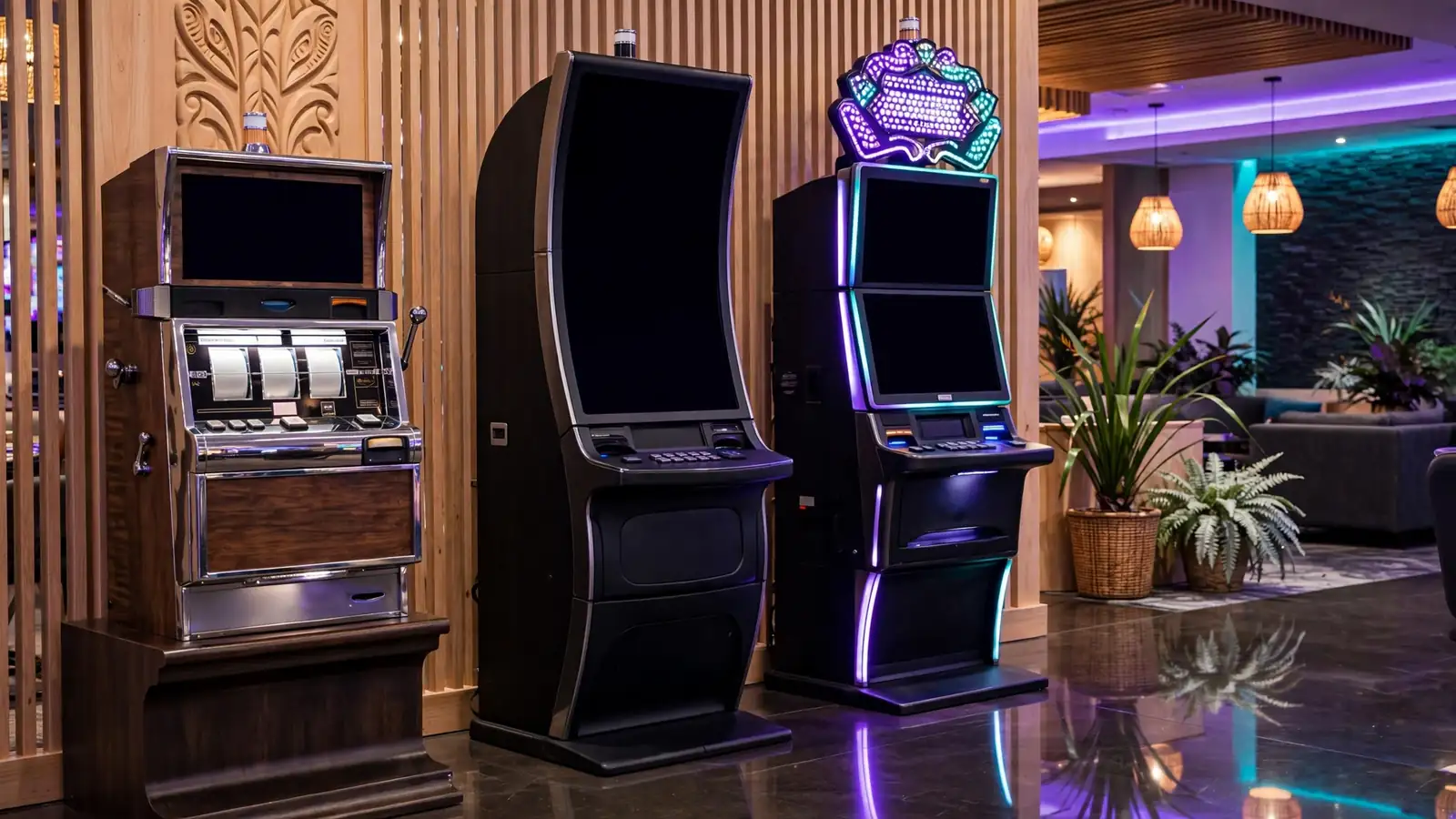
The oldest visual grammar of casino pokies is spare: three reels, a line of symbols, and no bonus round waiting behind the main game. The format makes its terms visible. Symbols settle; matching ones form a win according to the game’s paytable. There is little machinery between the spin and its result, which is part of the appeal. A classic game can feel almost like a pocket-sized relic of the mechanical machines that once made their workings public through spinning drums and clacking stops.
Feature a spare visual grammar with three reels and a simple line of symbols without bonus rounds.
Offer a busier vocabulary with five reels, wilds, scatters, and dedicated free-spins rounds.
Video pokies use a broader screen and a busier vocabulary. They commonly have five reels, with wilds that can stand in for other symbols, scatters that can trigger features, and free-spins rounds that temporarily change the play. Those additions give designers more ways to shape a theme and a sequence of events. They also mean that the main reels may be only the opening scene: a scatter combination, for instance, can lead into a separate round rather than simply paying in the base game.
The distinction is not a ranking. A player who prefers a clear, compact structure may find the classic format easier to follow; someone drawn to layered themes may prefer the moving parts of video pokies. Neither format tells the whole story of a game’s behaviour, and visual complexity is not evidence of better prospects. The design describes what happens on screen, not what any particular session will deliver.
This is why the word “pokies” covers experiences that look quite different despite sharing the same basic act of spinning reels. In New Zealand, where the machines have a long place in everyday gambling culture, the word carries a local familiarity that “slot” never quite acquired. Online, the physical cabinet has disappeared, but the contrast between the stripped-back machine and the feature-rich video game remains.
A simple format is not necessarily a simple decision. Paytables and feature descriptions still matter, and two games that look alike may work differently. The reels are the visible part; the rules underneath are the quieter part.
Jackpots, Crash Games and Bonus-Buy Rounds
Some pokies attach a prize pool to ordinary play. In a progressive jackpot game, contributions from spins across casinos running that game gather in a shared pool. The prize can grow while the base game keeps turning, but the pool has a cost: part of each bet is diverted to the jackpot, leaving the base game with a lower RTP. The headline prize and the return built into routine play are not the same measure.
That distinction can make a jackpot look larger than the game’s everyday mathematics. A growing pool is visible; the share taken from each wager is easier to overlook. The prize is the spectacle. The trade-off sits in the background.
Crash games discard reels altogether. A multiplier rises, and the player must cash out before it crashes. The tension comes from choosing when to stop: wait longer and the multiplier may climb, but a crash before cash-out ends that opportunity. The game’s central mechanic is therefore a decision under uncertainty, not a sequence of symbols landing on a line.
Bonus buys offer a different shortcut. Instead of waiting for a bonus round to arrive through ordinary play, a player pays a fixed multiplier of the stake to enter it directly. A specialist review describes costs ranging from 50 to 100 times the stake, depending on the title. That is not a small adjustment to a spin; it changes the amount committed at once. The attraction is immediate access to the feature, while the cost is immediate too.
Game Mechanics
- Progressive jackpots divert part of each bet to a shared pool, lowering the base game RTP.
- Crash games rely on timing and decision-making under uncertainty rather than reels.
- Bonus buys allow immediate access to features in exchange for a fixed multiplier of the stake.
These mechanics give casino pokies games distinct rhythms. A progressive jackpot ties individual spins to a wider pool; a crash game turns timing into the main decision; a bonus buy exchanges gradual entry for a much larger stake. None removes uncertainty. Each simply places it somewhere different: in the jackpot’s long accumulation, the crash point, or the price paid before the bonus begins.
Promo Codes and the Cost of Bonus Conditions
A promo code can look like the offer itself: a short string entered at registration or when claiming a promotion. In practice, it is only a key to the offer’s terms. Those terms determine what counts towards wagering, which games qualify, and whether a particular feature is excluded. The code may be simple; the conditions are where the cost becomes visible.
Bonus-buy rounds make that distinction especially important. A specialist review of bonus conditions reports that these features can cost 50 to 100 times the stake, while usually being excluded from wagering requirements on promotional funds. The multiplier is not a universal price: it depends on the title. But the exclusion matters either way. A costly purchase may contribute nothing to clearing a bonus, even when the game itself appears in the casino’s catalogue.
That creates an awkward mismatch between two kinds of spending. A player may use promotional funds expecting eligible play to advance the offer, then find that a bonus-buy purchase does not count. The money is spent, but the wagering condition remains. A promo code cannot make an excluded feature eligible; only the offer’s written terms can establish what qualifies.
The same caution applies to the headline attached to a code. The practical value of an offer depends on its restrictions, not merely on the amount or wording used to advertise it. Conditions can set out eligible games and other limits, so the code alone is not enough to judge what the promotion permits. Current wagering requirements should be checked before claiming any bonus.
Bonus buys are therefore not simply a faster route into a round when promotional funds are involved. Their price may be substantial, and their treatment under an offer may be different from ordinary spins. The small print has the final say.
Real Online Pokies and the Limits of Local Protection
“Real” online pokies means play for money rather than a demonstration mode. The distinction matters, but it does not tell a player how a disagreement will be handled. A game can be genuine, and a balance can be displayed on screen, while the service remains beyond the reach of New Zealand’s domestic consumer-protection system.
For people in New Zealand, the central difficulty with an offshore site is not simply that it is based elsewhere. It is that the Department of Internal Affairs does not oversee it. If a dispute arises, there is no local consumer protection agency responsible for resolving it on the player’s behalf. That leaves a gap between being able to use a service and having a domestic body to turn to when the service is contested.
The gap can become visible over ordinary matters: what a transaction meant, whether a site has applied its own rules correctly, or how a complaint is treated. Those examples do not establish that a particular operator has acted improperly. They show why the location and oversight of a service matter when money is involved. A complaint made to the business is not the same thing as recourse through a local public agency.
This is a quiet distinction, and an important one. Access is not protection. A platform may be reachable from New Zealand without being supervised by New Zealand authorities; the player’s ability to take part does not create a local regulator for the operator. In a dispute, the absence of that domestic route changes the practical position, even where the player has done nothing unlawful.
That is the limit behind the promise of real-money play. The screen may make the service feel near at hand; responsibility for the dispute is not necessarily near at hand at all. New Zealand players using offshore sites lack a local consumer-protection agency with oversight of those platforms. The distance is institutional, not merely geographical.
Written by the editors at Casino Slots Hub NZ.