Casino Slot Machines in New Zealand: How They Work
 Available in US
Reel layouts, independent spins and bonus terms all shape how pokie play looks and what a session can cost.
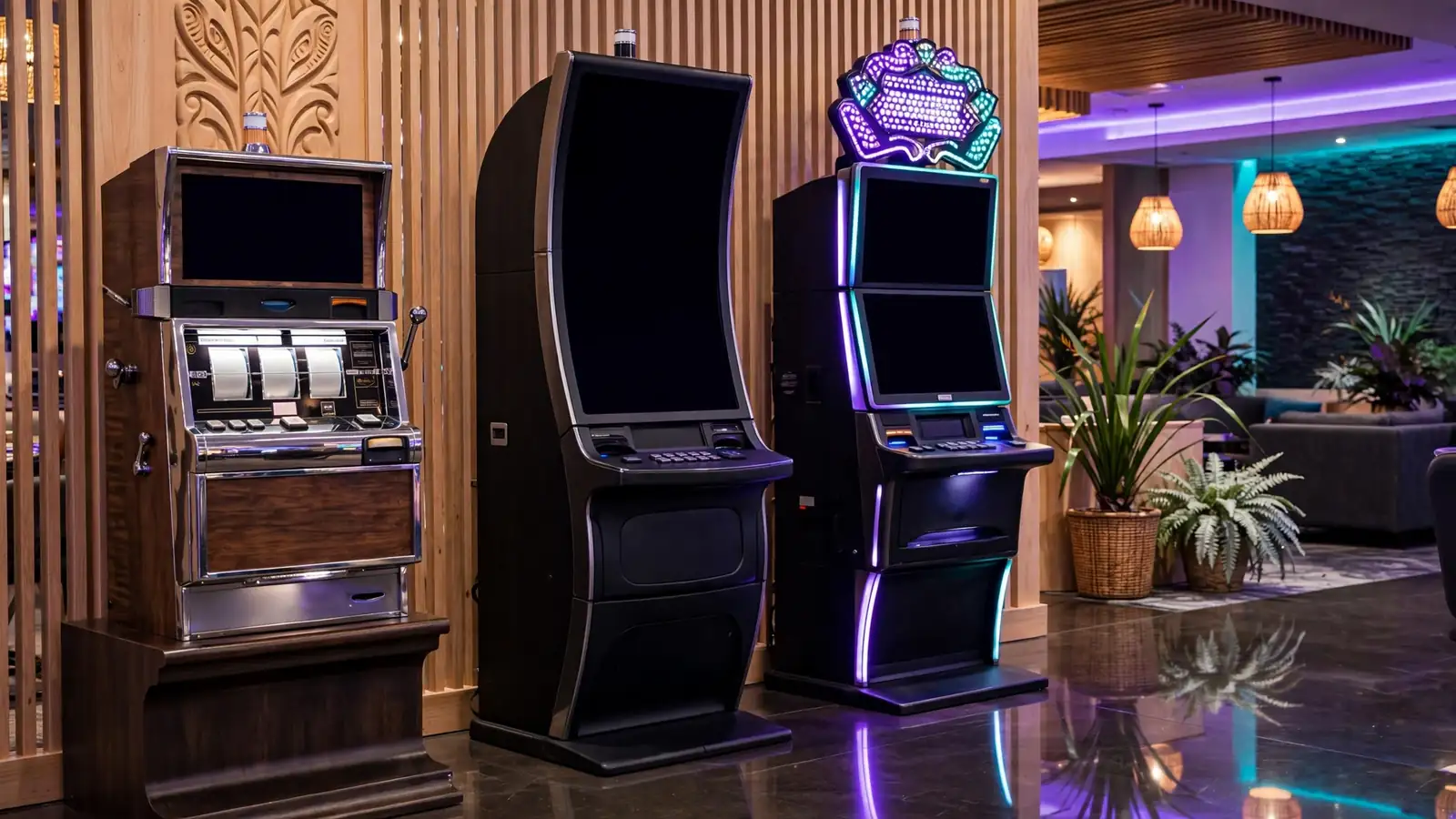
Table of Contents
- The Many Shapes of a Pokie
- A Slot Machine on a Screen
- What a Win Means Over Time
- The Fine Print Behind Slot ‘Secrets’
- Strategy in a Game of Independent Spins
- How the Spin Is Decided
- Features That Give Slots Their Changing Rhythm
- Real-Money Play and New Zealand’s Licensing Shift
- Can a Slot Machine Be Tricked?
- A Winning Session—and the Cost of a Bonus
The Many Shapes of a Pokie
A pokie can announce its design before a spin begins. Reels, symbols and the space they occupy give each format a different visual grammar: the compact order of a classic game, the more elaborate screen of a video pokie, or the shifting grid of a Megaways title. These are not merely different skins over the same-looking machine. The arrangement determines what the eye has to follow.
The classic format keeps its promise simple. Three reels sit in view, with symbols arranged in columns and a comparatively spare presentation. Its familiar shape carries something of the old mechanical machine into the screen era: a small set of moving parts, a clear central display, and little visual distance between the reels and the idea of a result. The design is easy to read at a glance. There is less on the screen competing to explain itself.
That restraint suits the classic pokie’s character. These games typically pay smaller wins more often than high-volatility titles. The distinction is not a claim that every spin will feel busy or rewarding; it describes the style of the game across play. Visually, the three-reel layout makes the basic arrangement legible without asking the player to keep track of multiple layers of symbols or features. Familiarity is part of the appeal. The machine looks like what it is.
Choosing a slot casino in New Zealand for 2026 calls for checking the specific details available about each operator. This overview highlights the stated licensing or payout information to help readers assess the options.
Payout speed: 1-3 business days Wintino lists a payout speed of 1–3 business days.
License: Curaçao Gaming Authority, licence no. OGL/2024/165/0185 BitStarz lists a Curaçao Gaming Authority licence, no. OGL/2024/165/0185.
License: Malta Gaming Authority, licence no. MGA/B2C/370/2017 Play Grand lists a Malta Gaming Authority licence, no. MGA/B2C/370/2017.
License: Tobique Gaming Commission, licence no. 0000091 7Bit Casino lists a Tobique Gaming Commission licence, no. 0000091.
License: Tobique Gaming Commission, licence no. 0000064 Neospin lists a Tobique Gaming Commission licence, no. 0000064.
License: Tobique Gaming Commission, licence no. 0000002 Ricky Casino lists a Tobique Gaming Commission licence, no. 0000002.
License: 07017519840 · Payout speed: 1-3 business days Zotabet lists licence reference 07017519840 and a payout speed of 1–3 business days.
Payout speed: 1-3 business days Lamabet lists a payout speed of 1–3 business days.
License: Malta Gaming Authority, licence no. MGA/B2C/394/2017 N1 Casino lists a Malta Gaming Authority licence, no. MGA/B2C/394/2017.
Video pokies make a more expansive impression. They typically use five reels and may include wilds, scatters and free spins. Those symbols and features give the screen additional roles: a symbol can stand in for another, appear as a trigger, or lead into a free-spin round. The reels remain the central structure, but the game’s vocabulary grows around them.
That expansion changes the feel of looking at the screen. Five reels offer more room for symbols and combinations to appear, while special symbols ask for a second kind of attention: not only what has landed, but what a particular symbol does within the game. A scatter, for instance, is not simply another decorative image; it belongs to a feature system. Wilds and free spins likewise give the display meanings beyond the ordinary symbols. The details vary between games, so the name of a feature does not, by itself, explain every rule attached to it.
Video design also allows a game to place more of its identity on screen. Artwork, animation and sound can make the reels feel like one element in a larger scene. Yet the basic format is still visible beneath the presentation: five reels, symbols, and features that may change what happens within a round. A lavish backdrop does not make the underlying structure less important. It just gives it company.

Megaways changes the structure more directly. Instead of keeping the same number of symbols on every reel from one spin to the next, a Megaways game varies that number. The grid therefore changes shape as it is played. A reel may occupy more or less vertical space, and the visible arrangement does not remain fixed in the way a conventional reel display does.
This shifting layout is the format’s defining visual cue. A player is not simply watching a familiar set of columns repeat; each spin can present a different number of symbol positions on each reel. The result is a display whose height and density can change, making the screen feel less like a fixed window and more like a changing field of symbols. It is a conspicuous design choice, not a subtle one.
The number of possible ways to win is tied to that changing arrangement. Some Megaways titles can offer as many as 117,649 ways to win on a single spin. That figure describes the scale of the format, not a promise that a particular spin will produce a win. The important distinction here is what the screen makes possible: the number of symbol positions can vary, and the game’s ways of forming combinations expand accordingly.
These formats are easiest to distinguish by looking at what stays put and what changes. In a classic pokie, the three-reel structure is the point. In a video pokie, five reels share the stage with wilds, scatters and free spins. In Megaways, the number of symbols on each reel shifts from spin to spin, changing the visible grid itself.
Three reels with a compact layout and simple presentation, typically offering smaller wins more frequently.
Five reels featuring wilds, scatters, and free spins, allowing for more expansive gameplay and complex features.
A shifting grid where the number of symbols on each reel varies per spin, potentially offering up to 117,649 ways to win.
The names can overlap in the wider world of game design: a game may borrow familiar symbols or elaborate presentation while still belonging to a recognisable format. But the basic shapes remain useful. Three reels keep the view compact; five reels and feature symbols give video pokies more moving parts; Megaways makes the reel heights variable. Before any question of what a game pays or how its software works, there is this first distinction: what the machine puts in front of the eye.
A Slot Machine on a Screen
A pokie on a screen arrives by one of two broad routes. In a web-based casino, the games can be played without downloading software to the computer. In a download-based casino, a software client must be installed before play and wagering can take place. The difference is not in the visible cabinet or the idea of a reel; it is in how the game reaches the screen.

The browser route keeps the entrance comparatively spare. A person opens the casino’s website, finds a game and plays there, without first installing a dedicated client on the local computer. The browser is the doorway; the game is presented through the online service. That makes the format easy to describe, if not necessarily more convenient in every circumstance. No separate client is required for access.
This distinction matters because the word “online” can make two quite different arrangements sound identical. Both are played through an internet-connected service, yet only one requires the user to obtain and install a casino program. In the web-based version, the computer’s browser provides the immediate setting. In the download-based version, the casino’s own client becomes part of the route to play.
The client changes the first encounter. Before reaching a game, the user must download the software and install it on the computer. The client is not an optional decoration: it is required to play and wager through that kind of casino. The format therefore places a preparatory step between deciding to play and arriving at the game. A small threshold, but a threshold all the same.

That difference also shapes what “access” means in ordinary language. With a browser-based service, access means opening the casino online and using its games without adding a casino program to the computer. With a downloadable service, access includes having the required client in place. Neither description says anything by itself about the games’ design, their chances of paying, or whether a particular spin will win. Those are separate questions. Here the issue is delivery.
The contrast resembles the difference between reading something in a browser and using a dedicated application, though the analogy has limits: a casino client is specifically required for playing and wagering on the download-based service. It is not enough merely to visit the site. The software has a practical role in the route the operator provides, even if the player’s attention is soon absorbed by the game itself.
This can make the choice less dramatic than it sounds. A screen-based pokie may look like a self-contained object, with its own frame and buttons, but what appears on the display depends on the way the service has been made available. In one format the browser is sufficient; in the other, the service asks for its own software client. The visual theatre may obscure the distinction. The installation step does not.
- Use a web-based casino to play directly in your browser
- Install the required software client for download-based casinos
- Expect to play a download-based casino without installing its client
- Confuse the delivery method with the game’s internal design
There is a quiet cultural shift in that change of setting. The traditional machine made its location obvious: it occupied a room, drew a person towards a particular counter or corner, and could not be mistaken for a private household object. Online, the room is reduced to a screen, while the means of access becomes less visible. A browser window leaves little trace of the route by which the game arrived. A downloaded client makes that route more tangible, because software must be placed on the computer before play begins.
That observation is about the form, not a claim that one route is safer, faster or better. The available distinction is narrower and more useful: web-based casinos do not require a local software download to play their games, whereas download-based casinos do require a client for playing and wagering. The first keeps the casino in the browser; the second asks the computer to host a dedicated program.
For a slot machine casino encountered on a screen, then, the choice of format is a choice about the doorway. One opens in the browser, without a separate client. The other begins with a download and installation. Neither route changes the fact that the game is being played online; they differ in what must happen on the computer before the play can begin.

The old machine stood in public. Its modern counterpart may be a browser page or a program installed at home. Different thresholds, same small screen.
What a Win Means Over Time
A payout can be counted in cash, but it can also be described as a pattern stretched across an immense span of play. Two measures help explain that pattern: RTP and volatility. Neither tells the story of a particular session. One describes a game’s return across its lifetime; the other describes the shape of its payouts.
RTP means Return to Player. It is the percentage of the total amount wagered that a game pays back over its entire lifetime. The phrase sounds like a promise addressed to each player, but its time scale is much wider than any single visit to a pokie. It is a long-run measure, not a forecast of what will come back during an evening, or what one person will collect.
That distinction matters because percentages acquire a misleading intimacy when they appear beside a game. They can seem to offer a personal expectation, as though a player’s money were being measured out against a known return. In fact, the measure belongs to the game’s whole life of play. A short stretch may produce a very different result. The number describes the broad return pattern, not an appointment with a payout.
Nor does RTP describe the size or rhythm of individual wins. A game can return money in frequent, modest amounts, or have long quiet passages interrupted by larger payouts. That difference is captured by volatility. It is a description of how wins tend to be distributed, not another way of expressing the long-run return.
Low-volatility pokies pay out regularly, but the amounts tend to be smaller. High-volatility games can leave longer intervals without a payout, with larger wins when they arrive. The contrast is less a ranking than a difference in temperament: one offers a more even sequence of smaller returns, while the other is marked by stillness and sharper peaks.
RTP measures the total amount a game pays back over its entire lifetime, whereas volatility describes the rhythm and distribution of those payouts.
The two measures answer different questions. RTP concerns the proportion returned across a game’s lifetime. Volatility concerns the pattern of payouts within play. A game’s RTP, by itself, does not reveal whether its returns are likely to arrive in frequent small sums or in less frequent, larger ones. Volatility, by itself, does not say how much is returned over that long span. Confusing them makes a technical description sound more complete than it is.
There is also a human reason the distinction is easy to lose. People remember a striking win, especially one that breaks a quiet run, more readily than a long sequence of uneventful spins. The visible moment becomes the story; the long-run measure recedes into the background. But neither a memorable payout nor a frustrating stretch changes what RTP is intended to describe. It remains an aggregate measure, not a character assessment of one player’s luck.
For casino slot machine wins, then, “over time” is doing substantial work. RTP belongs to a duration beyond the reach of an ordinary session; volatility gives a sense of how uneven or steady the payouts may feel along the way. Together, they provide a vocabulary for comparing outcome patterns without turning them into guarantees. A figure can describe the game. It cannot tell an individual what a visit will bring.
The distinction is modest, but useful: return is not rhythm, and neither is a receipt.
The Fine Print Behind Slot ‘Secrets’
The word “secret” gives an ordinary percentage a theatrical coat. A claim that a pokie pays more generously can sound like a clue hidden in plain sight, especially when an online casino places an audit beside it. But a published figure is a claim to examine, not a private route to better results.

Some online casinos advertise higher slot payback percentages and publish payout audits on their websites. That may offer more information than an unsupported boast, but the presence of an audit does not, by itself, explain what was checked or how the figure should be read. The document needs context: which games it covers, what period it concerns, and whether the stated result is tied to the games being discussed. Without those details, a prominent percentage can be more decorative than illuminating.
An audit also cannot turn a long-run measure into a forecast for an individual session. Its value lies in describing the basis of a claim, not in promising that a particular run will resemble it. This is the distinction that “secret” language tends to blur: evidence about a published figure is not evidence of a way to call, time or improve a spin. A verified-looking number still has a narrow job.
The wording around the figure matters. “Higher” needs a comparison: higher than which games, or which stated baseline? A casino may use the phrase as a broad selling point, while the audit may relate to a more limited set of titles. The two should not be treated as interchangeable. Nor does a document on a casino’s own website automatically settle every question about its scope or independence. Its source and stated coverage remain part of the claim.
There is a social history in this language. Gambling has long been sold with the suggestion that knowledge separates the fortunate from the rest; a modern audit lends that old promise the appearance of administration. The paperwork may be useful. The mystique is not.
A published payout audit is a claim to examine, not a guarantee of a particular result or a secret route to better outcomes.
A careful reading therefore asks what the audit actually supports, rather than treating its existence as proof of a secret advantage. If the claim is precise, the explanation should make its limits legible. If it leaves the comparison or coverage obscure, the uncertainty belongs to the claim—not to the player’s failure to discover a hidden technique. No secret there.
Strategy in a Game of Independent Spins
A strategy for playing a pokie can shape the session, but it cannot turn a chosen spin into a more favourable one. Each spin is independent: what happened before does not make a win more likely next time, and a quiet run does not mean the game is “due”. The distinction is easy to lose when a sequence of results starts to feel like a story with a promised ending.
That is where practical choices matter. A player can decide in advance how much money is available for play, set a maximum loss, and stop when that limit is reached. The limit does not alter the game; it marks the point at which the session ends. Chasing losses reverses that logic. It lets earlier spending dictate later decisions, although those earlier spins have no influence on the next one.
Time can be bounded too. A session that has no stopping point can expand by habit, especially when repeated spins make minutes blur together. Taking a break or ending play at a chosen point is not a way to improve the odds. It is a way to keep the activity within limits set outside the game.

This is the modest territory of casino slot machine strategy: managing participation, not controlling results. A player may choose when to begin, how much to spend, and when to leave. None of those choices can make a particular spin pay. Nor does a pattern noticed in recent results supply a reliable instruction for what to do next. The mind is a diligent pattern-maker, even when the game offers no pattern to act upon.
A plan is useful only if it remains a plan after a win or a loss. A win can tempt a longer session; a loss can invite another attempt to recover the money. Neither changes the independence of the next spin. Sticking to a pre-set limit therefore means accepting that the session may end without the result hoped for, rather than treating extra play as a correction.
There is no technique for making the machine compensate for previous outcomes. Strategy belongs to the boundary around play: the spending limit, the stopping point, and the decision not to chase. Inside that boundary, each spin remains its own event. Dry arithmetic.
How the Spin Is Decided
A virtual pokie does not need a wheel turning behind the screen. Its result comes from software: a pseudorandom number generator, or PRNG. The phrase sounds more mysterious than the work it describes. The program produces values through a mathematical process, and those values determine the outcome shown to the player.
“Pseudo” matters. A computer follows instructions; it does not summon the kind of chance associated with shuffled cards or a tossed coin. A PRNG uses an algorithm to produce numbers that appear random. In a virtual slot, the software uses those generated values to settle the spin. The animation follows, making the result visible as symbols move and stop.
How PRNG works
A pseudorandom number generator (PRNG) uses a mathematical algorithm to produce values that appear random. These values determine the spin’s outcome before the visual animation of the reels begins.
That order is easy to reverse in the imagination. Reels spin across the screen, so it can seem as though their movement gradually creates the result. But the animation is the display, not the mechanism deciding what happens. The visual performance gives a computational event a familiar stage: symbols, motion, a pause, then a settled picture.
The same distinction applies to sounds and other flourishes. They can make a spin feel suspenseful or celebratory, but they are not evidence of how its result was chosen. A bright sequence may accompany a result; it does not establish that the software changed its decision along the way. The screen tells a story about the outcome. It is not a window into the program’s calculations.
This is why a virtual casino game is not best understood as a small mechanical cabinet reproduced on a phone or computer. Its visible elements borrow the vocabulary of physical machines, while the decision is made in software. The PRNG is the technical source; the reels and symbols are how that source is presented to a person watching.
There is something revealing in that arrangement. Gambling has long relied on objects that make chance visible: cards turned over, wheels slowing, counters dropping. Digital play keeps the ceremony and replaces the object at its centre with an algorithm. The gesture remains. The machinery changes.
The term “pseudorandom” can invite speculation that a result is therefore readable or steerable. It says no such thing. It identifies the software process used to generate outcomes; it is not an invitation to infer a hidden pattern from the screen. A player sees the rendered result, not a useful map of the program.
A neat little theatre.

Features That Give Slots Their Changing Rhythm
The visible reels are only part of a pokie’s character. Some features alter what a spin contributes, when a bonus begins, or how long a player waits before deciding to collect a rising return. They change the pace of play, not the basic uncertainty of its result.
A progressive jackpot turns individual spins into contributions to a shared prize. Each spin adds to the pot across the casinos running that game, so the prize is not funded by one player’s session alone. The arrangement gives a solitary action a collective shadow: many players, in separate places, feed the same total. That communal quality is more appealing in theory than it is sociable in practice.
A bonus buy changes the route into a bonus round. Rather than waiting for the feature to arrive through ordinary play, a player pays a fixed multiplier of the stake to enter it directly. Some specialist reviews describe this mechanic, though its availability and terms depend on the individual game. It is not simply a shortcut to a better result; it exchanges a waiting process for an immediate, separately priced feature. The attraction is obvious. So is the cost of making anticipation optional.
Crash games create a different sort of tension. A multiplier rises while the game continues, and the player must cash out before the game crashes. The longer the rise, the larger the potential multiplier; but waiting also risks losing the chance to take the displayed return. The central drama is not a reel stopping on a symbol, but a decision made while a number climbs. Briefly, the player is cast as a trader, though without control over the market.
Special Features
- Progressive jackpots create a shared prize pool funded by many players.
- Bonus buys allow immediate entry into bonus rounds for a fixed cost.
- Crash games shift the focus to timing a cash-out as a multiplier rises.
These mechanics give casino pokies markedly different rhythms. A progressive pot accumulates in the background; a bonus buy compresses the wait; a crash game makes the moment of stopping part of the spectacle. None turns uncertainty into a dependable method. The features shape how play feels and where its pressure gathers, rather than offering a reliable way to dictate the outcome.
Real-Money Play and New Zealand’s Licensing Shift
Demo mode offers a way to see how a pokie behaves without wagering real money. It can show the game’s mechanics, but it is not a rehearsal for every part of real-money play: progressive jackpots do not pay out in demo mode. The distinction is more than a screen setting. A simulated spin carries no financial stake; a real one does.
New Zealand’s legal position is changing, though not by turning every online casino into a locally licensed one overnight. The Gambling Act 2003 prohibits online casinos from being based in New Zealand. Its focus is on operators running such services from within the country, not on punishing players simply for using an offshore site.
For years, online casino services provided from outside New Zealand were not licensed or supervised by a New Zealand regulator. A customer using an offshore website in that period had no domestic government recourse if a dispute arose. Access and protection were not the same thing.

The Online Casino Gambling Act 2026, which came into force on 1 May 2026, established New Zealand’s first domestic licensing framework for online casino gambling. It does not immediately place every service under the new system. A transitional period runs from 1 May to 1 December 2026: providers already serving people in New Zealand before the Act came into force may continue during that period, subject to the Act’s transitional provisions. The full licensed regime is not expected to be operational until 2027.
That transition matters. A familiar website is not, by familiarity alone, evidence of a New Zealand licence. Nor does the new framework mean that domestic online casinos, previously prohibited, have simply become ordinary local businesses. The country is moving from a period without domestic oversight of offshore services towards a licensing system, with the Department of Internal Affairs responsible for the framework.
The practical difference between demo and real-money play therefore sits inside a larger change in public policy. A demo can explain a game, while the legal setting determines who may provide it and what local oversight exists. The change is gradual, and the dates matter. Licensing is not yet the same as full operation.
Can a Slot Machine Be Tricked?
The notion that casino slot machines can be tricked gives old habits a modern costume. A player may treat a sequence of losses as evidence that a machine has reached a turning point, or take a recent win as a signal that another is close. But each spin is independent. The machine is not keeping a debt ledger, and it does not owe the next player a correction.
Independent Spins
Each spin is an independent event; previous losses do not make a win more likely, and the machine never owes a correction.
Independence is a plain idea with stubborn consequences: what happened on the previous spin does not make a win more likely on the next. A run of empty results does not build pressure towards a payout. Nor does a win leave the game temporarily drained. Patterns can be visible in a short stretch of play, but visibility is not proof of a hidden arrangement. Random sequences often look meaningful after the fact; people are skilled at finding a story in a handful of events.
That instinct has deep roots. Games of chance invite rituals because ritual gives uncertainty a handle. A pause, a preferred time, a repeated button press: each can make play feel orderly, even when the outcome remains beyond the player’s control. The comfort is human. The influence is another matter. Changing the timing or rhythm of a spin cannot turn an independent result into a predictable one.

The same distinction applies to claims that a game can be persuaded, warmed up or caught at the right moment. Such language turns chance into a negotiation, with the machine cast as an opponent whose habits can be read. Yet the idea depends on treating earlier spins as clues to a future result. They are not. A game is never “due” a win simply because it has gone without one.
There is a quieter danger in the search for a trick: time and money can be spent testing a belief that has no reliable mechanism behind it. Setting a maximum loss limit before play does not change the result of any spin, but it does put a boundary around the session. That is a real choice, unlike an attempt to make the machine respond to a pattern.
Chance has no memory. That is the whole trick.
A Winning Session—and the Cost of a Bonus
A winning session and a withdrawable balance are not always the same thing. Cash won from a spin is one matter; promotional funds may come with conditions that must be met before any associated winnings can be withdrawn. The distinction lives in the terms, not in the celebratory animation.

Casino bonuses commonly carry a wagering requirement: a specified amount must be wagered before withdrawal is allowed. A specialist review describes welcome-bonus requirements in the range of 30x to 50x. The multiplier matters because it applies to a stated base, which may be the bonus or the bonus and deposit together. The offer’s own wording determines which. Without that detail, the headline value tells only part of the story.
A second condition can govern the size of each bet while a bonus is active. A specialist review describes a NZ$5-per-spin maximum as a typical cap; breaching a stated limit can put bonus winnings at risk. That makes the bet-size rule more than small print. A session can produce a win and still fail to qualify under the offer’s conditions.
Time can narrow the opportunity further. A specialist review describes bonus expiry periods ranging from 7 to 30 days, depending on the site. Expiry may apply to the promotional balance or to the time allowed to meet the wagering requirement, so those details should not be treated as interchangeable. A deadline changes the practical value of an offer, particularly if meeting its conditions would require play that was not otherwise planned.
Game eligibility matters too. A specialist review describes slots as commonly counting fully toward wagering, while some games may be excluded or contribute less. A spin on an ineligible title may therefore do little or nothing to clear the requirement. The offer’s game list and contribution rules determine what counts.
The useful comparison is not simply between a bonus figure and a winning result. It is between the conditions attached to the funds and the amount of play those conditions demand. Promotional money is not automatically cash, and a win does not erase the terms accepted along the way.
Before play, a maximum loss limit can keep spending within a chosen boundary; increasing bets to chase losses only adds risk. Withdrawal may also require identity verification. The terms deserve attention before an offer is accepted, when the decision is still uncomplicated. The celebration can wait.
Written by the editors at Casino Slots Hub NZ.