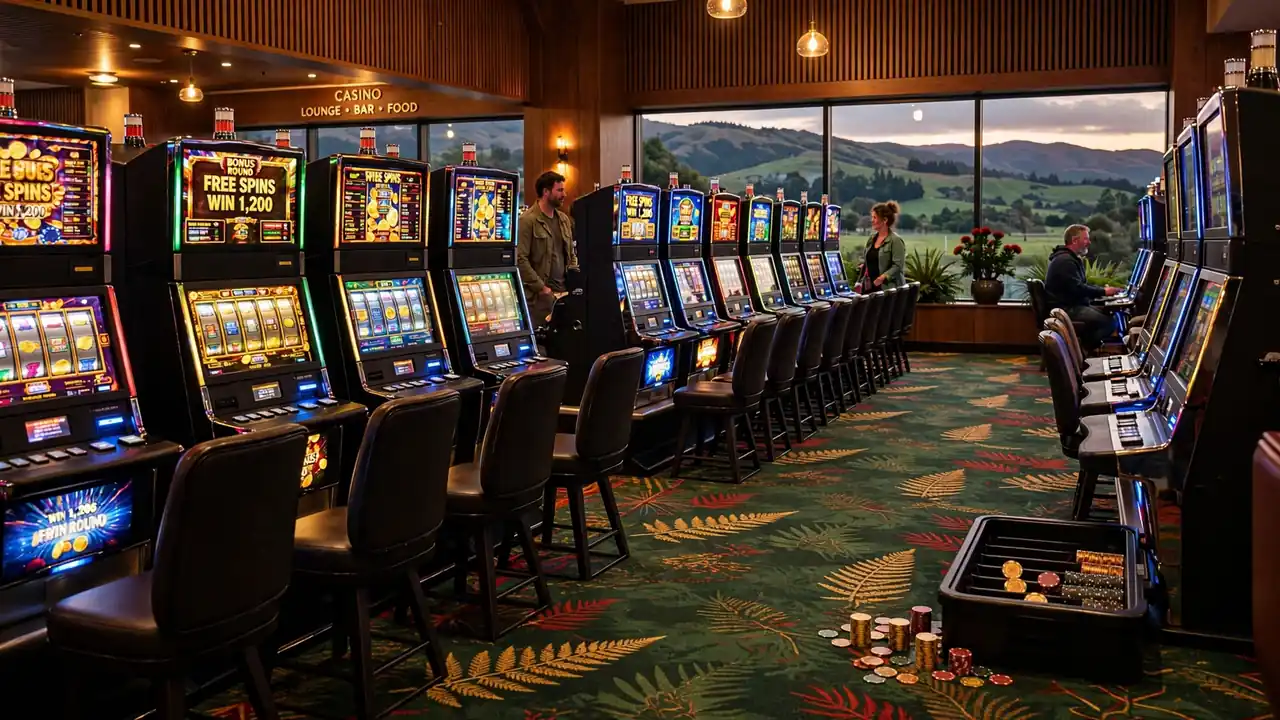
Newest Casinos in New Zealand: What “New” Means
 Available in US
The guide weighs offshore status, bonus arithmetic, licensing paperwork and withdrawal approval without treating a new label as proof of quality.

Table of Contents
- What “new” means in a market built offshore
- Bonus codes come with arithmetic
- RTG, crypto and the limits of a label
- New Zealand’s online casino rules are still changing
- “Best” is not the same as a sensible bet
- Casino sites and the paperwork behind them
- The newest game is not established by these facts
- Real-money play ends at the withdrawal counter
- How to read a new-casino shortlist
- Bitcoin withdrawals: speed depends on approval
What “new” means in a market built offshore
“New” sounds like a simple promise of freshness: a recently opened casino, a redesigned site, perhaps a fresh set of games. In New Zealand’s online market, the word carries a less tidy meaning. A casino can be new to a player without being newly established, newly licensed in New Zealand or even based here. The market has been built across borders, while the country’s laws have been catching up with the business conducted beyond them.
New Zealand residents can legally play at internationally licensed online casinos operating offshore. The Gambling Act 2003, however, does not allow online casinos to be based in New Zealand. Those two facts sit alongside each other: offshore participation is possible, but a locally based online casino is not permitted under that Act. The distinction matters because “newest casino in New Zealand” can sound like a claim about domestic openings, when it may refer instead to an overseas operator newly appearing in the choices available to Kiwi players.
That ambiguity has a history. Online gambling crosses borders with a peculiar ease: a site may be presented in English, accept customers from New Zealand and offer services through an overseas business structure, while having no physical casino in the country. The screen makes the distance feel negligible. The legal and institutional distance is not. A new website, a new brand or a refreshed interface does not, by itself, change where the operator is based or which authority regulates it.
Nor does the word “licensed” settle every question. Offshore online casinos may operate under licences issued in jurisdictions outside New Zealand. Such a licence belongs to the operator’s regulatory setting; it is not a New Zealand licence. For a long time, the country had no domestic licensing and supervision system for online casino services provided from overseas. That meant the market could be accessible to New Zealand players without being a locally regulated market. Availability and domestic oversight are different things, however neatly a site may place them on the same page.

The change now under way is more than a forecast. A specialist market review had described a government plan for a new licensing regime; since then, the Online Casino Gambling Act 2026 has established the legal framework for the country’s first domestic licensing system. The Act came into force on 1 May 2026. Its arrival is significant, but it does not mean every offshore casino has suddenly become licensed in New Zealand. A transition applies to providers already serving people in the country before the Act began, allowing them to continue operating until 1 December 2026 under the transitional provisions. The full licensed regime is not expected to be operational until 2027.
A period of transition is not a finished system. It is a bridge between an older arrangement, in which offshore services were not supervised by a New Zealand regulator, and a future in which domestic licensing is intended to govern online casino operators. The dates mark different stages, not a single moment when every site changes status. The new law also does not undo the basic distinction between an online casino based in New Zealand and an offshore operator serving New Zealand customers.
That is why the newest online casinos in 2026 cannot sensibly be understood as a list of fresh local openings. “Newest” may describe when a brand reached a particular audience, when a site changed its presentation or when it began appearing in local-facing material. It does not automatically describe the operator’s age, the location of its business or its position in the incoming New Zealand system. A new coat of paint is still paint.

The shift in regulation says something about the country as well as the industry. New Zealand is moving from a position where online casino services from abroad could reach local customers without domestic supervision towards a framework designed to license the sector at home. That is a consequential change, but the transition asks for careful language. The market is neither unchanged nor already fully domestically licensed. Both descriptions flatten the timing that matters.
So “new” is best treated as a description with a missing noun. New to whom? New as a website, a brand, a service, or a domestic licence? For a Kiwi audience, a recently encountered offshore casino may be new in the ordinary sense, while remaining part of a cross-border market shaped by older rules and a licensing system still coming into operation. The word itself cannot answer the regulatory question. Context has to do that work.
Bonus codes come with arithmetic
A welcome bonus is often presented as a sum added to a new account, but the figure is not the amount available to withdraw. A code may unlock bonus funds or another promotion; what those funds are worth depends on the conditions attached. The arithmetic begins after the offer is accepted, not when the headline amount appears.
Wagering requirements set the central calculation. A requirement of 35x on a $100 bonus means $3,500 in qualifying bets must be placed before the bonus winnings can be released. That is turnover, not a bill charged by the casino, but it still measures how much play stands between an advertised offer and a possible cash-out. Welcome-bonus requirements commonly fall between 30x and 50x. The difference between the low and high ends changes the amount of qualifying play substantially.

The base used for the multiplier matters, too. Terms may calculate wagering against the bonus alone or against the deposit and bonus together. The same multiplier can therefore produce different totals. A code with an attractive headline may carry a larger practical obligation if the deposit is included in the calculation. The wording in the promotion is not a footnote to the offer; it is the formula.
Time adds another constraint. Bonus terms commonly set a 30-day window for meeting wagering conditions. If the required play is not completed before the deadline, winnings tied to the bonus may remain unavailable. Incomplete wagering can prevent funds from being released, regardless of whether the account balance looks substantial. A balance on screen and a balance cleared for withdrawal are different things.
The small print changes the calculation
Deposits can be part of the bargain even when an offer is described as a no-deposit bonus. Some promotions require a later deposit before winnings can be withdrawn, with stated qualifying amounts ranging from NZ$5 to NZ$40. That condition turns “no deposit” into a narrower claim: no deposit may be needed to receive the initial promotion, while one may still be required to access its proceeds.
Other terms determine which bets count. Game contribution rules can mean that different games contribute differently towards wagering, or that some play does not count at all. A bonus can therefore be used up without clearing the requirement at the pace a player might expect. The distinction is easy to overlook: a bet can be real money at risk without being fully qualifying play.
The maximum bet while a bonus is active is another material condition. New Zealand’s market constraints set a ceiling of NZ$5 per spin during active bonus play. The offer’s own rules may impose a limit as well, and exceeding a bonus maximum can carry serious consequences. A specialist review has reported that an operator may confiscate the balance after a breach; that is not a harmless technicality. The amount of a permitted bet should be checked before play, rather than reconstructed after a disputed balance.
Bonus Breach
Exceeding the maximum bet limit of NZ$5 per spin during active bonus play may lead to the confiscation of your balance.
Expiry dates, excluded payment methods and withdrawal caps can narrow the offer further. An excluded payment method may make a customer ineligible for a promotion, while a withdrawal cap can limit what is payable from bonus winnings even after the wagering is complete. These conditions do not all affect the calculation in the same way, but each can change what the headline amount ultimately means.
A code is thus less like a gift card than a contract written as a set of thresholds. Its practical value depends on the multiplier, the base amount, eligible games, permitted bet size, qualifying deposit and deadline. The most generous-looking figure need not produce the most accessible winnings. Fine print has a talent for becoming the main event.
The same care applies to free spins and no-deposit offers. Their smaller entry requirement does not remove the conditions governing resulting winnings. Before accepting an offer, the full terms need to be read, including the wagering rule, time limit, game restrictions and maximum cashout. The cashier and promotions terms should be checked before committing money, and the bonus document should be read before any free-spin offer is accepted. “Free” describes the entry point, not necessarily the route out.
A useful comparison begins with the amount that must be wagered and asks what counts toward it. Then come the deadline, eligible games, maximum bet, deposit requirement and cap on winnings. If any of those terms are unclear, the advertised bonus cannot be treated as a settled amount. It is only an invitation to do the arithmetic.
RTG, crypto and the limits of a label
RTG and crypto describe different things. One is a label associated with casino software; the other refers to a form of payment. When both appear beside a casino’s name, they can create an impression of a neatly defined product: a particular kind of games, a particular way to deposit, perhaps a recently launched site. The labels do not, by themselves, establish any of that.

For someone in New Zealand, the grounded distinction is simpler. Residents can legally play at internationally licensed offshore online casinos. That tells something about where a service sits in relation to the country; it does not verify the software on a particular site, establish when the site opened, or confirm that its claims about payment options are accurate. A word on a banner is not a record of a launch.
This matters especially when a casino presents itself as new for 2026. A date can be part of a promotional identity rather than evidence of a recent arrival. “New” may suggest novelty, but it cannot tell whether the site is newly established, newly presented to a particular audience, or simply newly described that way. The calendar lends the claim a crisp edge. It does not supply the paperwork behind it.
RTG has a similarly narrow reach as a label. It may be used to signal a software connection, but the word alone does not identify which games are available, show that a particular platform uses that software, or establish that the site itself is new. Those are separate claims. Bundling them into one impression is convenient; treating them as equivalent is not.
Crypto can also be made to carry more meaning than it contains. Its presence in a description does not establish that every part of a casino’s service is crypto-based, nor does it verify that a named site accepts a particular asset. Payment language and software language can sit side by side in advertising, but neither confirms the other. Nor does either label turn an offshore casino into a New Zealand-based one.
Licensing Distinction
International licensing refers to the regulatory setting of offshore operators and is not a substitute for domestic New Zealand licensing.
There is a social habit at work here. Online services are often introduced through compact tags, because a few words can make an unfamiliar business feel legible. A casino becomes “RTG,” “crypto,” and “new” in a single breath. The categories sound like information; sometimes they are only the wrapping around a claim. The distinction is not academic when those words help frame a decision involving money.
The phrase “newest online casinos for 2026” therefore promises more certainty than a year and a label can deliver. It may point towards casinos being presented as recent, but it does not certify an opening date or a software arrangement. Likewise, calling a site one of the newest RTG casinos does not verify its platform, and describing it as a crypto casino does not verify the details behind that description. Each claim would need to stand on its own.
That leaves a modest but useful boundary. International licensing is the relevant general description for offshore casinos available to New Zealand residents; RTG and crypto are not substitutes for it. The labels may help describe how a service is marketed, but they cannot establish its age or verify its particular features. Newness is not a credential. Nor is a pair of fashionable nouns.

New Zealand’s online casino rules are still changing
New Zealand’s online casino rules sit between an old prohibition on domestic operators and a licensing system that is not yet fully in place. The Gambling Act 2003 prevents online casinos from being based in New Zealand. That has not stopped offshore websites from accepting Kiwi players, but it has meant that the services available locally have not historically been licensed or supervised by a New Zealand regulator.
Offshore operators may hold licences issued in Curaçao, Malta or Gibraltar. Those licences come from other jurisdictions; they are not New Zealand licences, and they do not turn a foreign-based casino into a locally regulated business. Before the new law, a customer using an offshore site had no domestic government body to turn to for recourse. The distinction is institutional, not cosmetic.
The position changed with the Online Casino Gambling Act 2026, which came into force on 1 May 2026 and established New Zealand’s first domestic licensing framework for online casino gambling. Its existence does not mean that a full local market was operating from that date. The Act instead set a transition period, with the complete licensing regime expected to be operational in 2027.
During the transition, online casinos that were already serving people in New Zealand before 1 May 2026 may continue to operate until 1 December 2026, subject to the Act’s transitional provisions. The boundary is therefore not simply between licensed and unlicensed websites: the timing of an operator’s presence in the market also matters under the transition rules. New entrants cannot assume that the same permission applies to them.
The government’s announced licensing regime was described in a specialist review as a change expected to arrive in the coming years. That account is now best read against the dates set by the Act: the legal framework has begun, while full operation remains ahead. A law can arrive before the machinery built to administer it is ready. That is not an unusual arrangement; it is simply a less tidy one than a launch announcement suggests.
Regulatory Transition
- The Online Casino Gambling Act 2026 established the first domestic licensing framework on 1 May 2026.
- Operators serving New Zealand before this date have a transitional period until 1 December 2026.
- The full domestic licensing regime is not expected to be operational until 2027.
- Unlicensed operation is expected to become an offence around mid-2027.
For players, the transition does not make every offshore site a New Zealand-licensed casino. Nor does it mean that a foreign licence is equivalent to domestic oversight. The legal categories are changing, but they remain separate: a site may be accessible to Kiwi customers under an overseas licence while the New Zealand licensing regime is still being established. Unlicensed operation is expected to become an offence around mid-2027, adding another future boundary to a system already moving through stages.
The practical effect is a market in passage. The old arrangement left offshore gambling outside New Zealand supervision; the new law creates a route to domestic licensing, with transitional permissions in between. The local rules are no longer merely proposed, but the finished regulatory structure has not yet arrived. A date in legislation is not the same thing as a completed system.
“Best” is not the same as a sensible bet
For a 2026 overview of casinos available to New Zealand readers, this list offers a concise starting point for reviewing the information available about each option. Check the details that matter to you before choosing.
Payout speed: 1-3 business days Wintino lists a payout speed of 1–3 business days.
License: Curaçao Gaming Authority, licence no. OGL/2024/165/0185 BitStarz lists a Curaçao Gaming Authority licence, no. OGL/2024/165/0185.
License: Malta Gaming Authority, licence no. MGA/B2C/370/2017 Play Grand lists a Malta Gaming Authority licence, no. MGA/B2C/370/2017.
License: Tobique Gaming Commission, licence no. 0000091 7Bit Casino lists a Tobique Gaming Commission licence, no. 0000091.
License: Tobique Gaming Commission, licence no. 0000064 Neospin lists a Tobique Gaming Commission licence, no. 0000064.
License: Tobique Gaming Commission, licence no. 0000002 Ricky Casino lists a Tobique Gaming Commission licence, no. 0000002.
License: 07017519840 · Payout speed: 1-3 business days Zotabet lists licence identifier 07017519840 and a payout speed of 1–3 business days.
Payout speed: 1-3 business days The available information for Lamabet lists a payout speed of 1–3 business days.
License: Malta Gaming Authority, licence no. MGA/B2C/394/2017 N1 Casino lists a Malta Gaming Authority licence, no. MGA/B2C/394/2017.
“Best” is a word that turns a choice into a contest. In casino advertising, it can suggest that a newer online casino is somehow a better place to bet: more generous, more exciting, perhaps more likely to make the numbers work. But freshness is not a measure of value, and a large bonus is not money already in a player’s pocket. The sensible question is how much play stands between an offer and a withdrawal.
Wagering requirements make that distance visible. Consider a NZ$500 bonus with a 30x requirement. Before the bonus winnings can be withdrawn, the qualifying wagering total is NZ$15,000. That is not a prediction of how much a player will lose; it is the volume of bets required by the condition. Still, each bet carries exposure, and a large turnover target can keep play going long after the original offer has stopped feeling like a gift.
The arithmetic also changes the meaning of “best”. A headline amount may be easy to compare, while the work attached to it is less conspicuous. The bonus becomes a project measured in repeated wagers, not a simple addition to a balance. New branding does not alter that calculation. Nor does the word “bet” make a promotional balance equivalent to cash.
There is a small social history in the language. Gambling offers have long borrowed the grammar of bargains: a prize is placed in view, while the conditions sit behind it. The arrangement is not mysterious; it is simply easier to notice the bright number than the obligation that follows. A sensible assessment begins with the latter.
While a bonus is active, the maximum bet limit must not be exceeded: the cap is NZ$5 per spin. Going beyond a stated limit can put the balance at risk, so the relevant terms need to be read before play begins. A hard stop set in advance also matters; losses do not become more recoverable because a bonus is still running. Chasing them only adds more exposure.
A label such as “best” can describe a promotion’s presentation. It cannot decide whether the required play is sensible for the person taking it on.
The distinction is plain. A bet is still a bet.
Bonus Assessment
- Calculate the total wagering volume based on the multiplier.
- Check if the wagering base includes only the bonus or also the deposit.
- Verify the time window available to meet the requirements.
- Confirm the maximum bet limit per spin.
- Identify the game contribution rules for eligible play.
Casino sites and the paperwork behind them
A casino website can look locally familiar while its legal home lies elsewhere. For New Zealand residents, that distinction is more than a detail in a footer: online casinos cannot be based in New Zealand under the Gambling Act 2003, while offshore operators may accept Kiwi players under licences issued in places such as Curaçao, Malta or Gibraltar.
The licence belongs to an institutional arrangement, not to the site’s appearance. A polished interface, familiar currency or New Zealand-facing language does not turn an offshore company into a domestic one. Nor does a foreign licence become a New Zealand licence by being displayed prominently. The paperwork points to the jurisdiction under which an operator says it is authorised to act.
That matters because a licence is not a decorative badge. It identifies a regulator and a legal framework outside New Zealand. Its presence can help explain where an operator’s formal oversight sits; it does not, by itself, establish that the site is locally supervised, or that every dispute will be handled in the same way as one involving a New Zealand institution. Offshore is a location, but also a distance between a customer and the rules governing the business.
The practical difficulty is that a website compresses several entities into one screen. The name on the homepage may not make clear which company operates the service or which jurisdiction its licence relates to. These are not interchangeable questions: the site is what a player sees, the operator is the business behind it, and the licence concerns the authority under which that business claims to operate.
A careful reading therefore separates the brand from the legal identity and the licence from the promise implied by its display. The point is not that a foreign licence has no significance; it is that its significance has a boundary. It describes an offshore relationship, not domestic establishment.
This is the paperwork behind the newer-looking casino sites as well as the older ones. A changed design or fresh name can alter the surface without changing the jurisdictional structure underneath. The useful distinction is not simply old versus new, but local versus offshore, and the latter remains the relevant description for these operators in New Zealand.
The footer is not the whole story. A licence can tell where the paperwork points; it cannot make an offshore site local.
The newest game is not established by these facts
“Newest” sounds like a simple property of a game, like its name or screen layout. In practice it depends on what counts as new: a first release, a later version, or the moment a particular casino adds it. Those are different events, and a title can be new in one sense without being the latest release overall.
A firm answer to what the newest online casino game is would need a dated release record and a clear scope. Is the claim about games released worldwide, titles available to New Zealand players, or additions to one casino’s catalogue? Without that distinction, “newest” is a moving label rather than a useful description. A page updated after a release could make yesterday’s answer stale.

There is another small complication: freshness is often made to sound like quality. A recent release may be interesting, but its date says nothing by itself about how it plays, whether its rules are clear, or whether it suits a particular player. Novelty is a calendar fact, not a verdict. The casino industry has always been good at dressing the calendar as an invitation.
For New Zealand players, a claim about availability also needs care. Online casinos are not based domestically under the Gambling Act 2003, while people in New Zealand can play at internationally licensed offshore sites. A game’s existence somewhere does not establish that it is offered by every site, or that it is accessible through a particular catalogue. Nor does a “new” badge explain who supplied the game or when it arrived.
The sensible way to read such a claim is to look for the title, its release date and the market or catalogue being described. If those details are absent, the word “new” does little work. A dated announcement can support a narrow statement about a release; a label on a casino page may only mean the operator has recently added it. The distinction matters more than the adjective.
Naming one without a dated basis would turn a time-sensitive question into a guess, and a guess dressed as a recommendation is still a guess. The more honest account is narrower: “newest” needs a date, a source and a defined market before it can mean anything dependable.
Freshness is not evidence.
Real-money play ends at the withdrawal counter
A balance on screen is not yet money in a bank account. The practical test of a real-money casino is the route from the cashier’s withdrawal button to funds that can actually be spent: the minimum permitted request, any cap on daily withdrawals, identity checks and the payment method’s own processing time.
A specialist review of withdrawal terms puts the industry’s stated minimums in a range of NZ$20 to NZ$50. That is a comparison point, not a promise that every site uses those figures. A separate specialist review describes NZ$4,000 to NZ$10,000 as a common daily cap. Such a ceiling matters most when a balance is larger than the amount the cashier will release in one day; payment may then be divided across requests or dates, according to the site’s terms.
The cashier can impose its own floor, while a bank or payment service may apply another. A displayed minimum therefore does not necessarily settle what can be withdrawn through a chosen method. The relevant terms are those attached to the withdrawal route, not merely the headline figure on a general payments page.
Verification is part of the transaction, not clerical decoration. A first withdrawal can take longer when the account needs a full know-your-customer check. Completing identity verification before requesting a withdrawal reduces the chance that a request will pause while documents are reviewed. The name and payment details on the account also need to align with the withdrawal method’s requirements.
For a verified account using a mainstream e-wallet, a specialist review estimates that the full journey—from the withdrawal request to spendable cash—can take 24 to 48 hours. The clock is not necessarily measuring only the casino’s processing: approval, account checks and the payment provider’s handling all sit between a click and usable funds. A different payment route may take longer, and an unresolved verification request can interrupt the timetable altogether.
Withdrawal Process
Complete the know-your-customer identity checks to avoid pauses during the withdrawal request.
Submit the withdrawal request via the cashier, ensuring the amount meets the minimum (typically NZ$20–NZ$50) and stays within daily caps.
Wait for the casino to review the request and verify the payment details.
Receive the funds via the chosen method, with crypto often taking minutes post-approval and banks taking one to three business days.
The useful comparison is therefore not simply “fast” against “slow.” Minimums decide whether a small balance can leave; caps determine whether a larger one can leave at once; verification affects when processing begins; and the payment method affects when the money arrives. Each is a separate gate. The cashier is the last one.
How to read a new-casino shortlist
A shortlist can make a crowded offshore market look neatly settled. It is not. A place on a list may show that a site is being presented as relevant to New Zealand players; by itself, it does not establish when the casino began operating, whether its terms have changed, or what protections apply to a particular account.
The distinction matters because the licence behind an offshore offer is not a New Zealand licence. Sites serving Kiwi players may operate under authorisation from Curaçao, Malta or Gibraltar. Those jurisdictions are not interchangeable labels for domestic oversight, and a shortlist that places them side by side does not explain what each one means for a player in New Zealand.

Nor does the word “new” settle much. It can describe a recent launch, a fresh appearance on a comparison page, or simply a renewed marketing claim. Without a clear basis for the label, the list cannot tell which meaning is intended. A polished entry is not a date stamp.
The useful reading is therefore narrower than the headline. A shortlist can help identify which offshore offers are being discussed, and it can signal that those sites may accept New Zealand customers. It cannot, merely by arranging names, prove that an operator is locally licensed or that inclusion amounts to a government endorsement. New Zealand residents may play at internationally licensed offshore casinos, but that fact does not turn an overseas licence into a domestic one.
There is a social history in this small distinction. Gambling has long travelled more easily than the rules meant to contain it; the internet has made that gap visible on a screen. Lists tidy the view. They do not close the gap.

A heading can rank. It cannot confer jurisdiction.
Bitcoin withdrawals: speed depends on approval
Bitcoin can make the last part of a casino withdrawal notably quick, but the clock does not start when a player presses the cash-out button. Before a payment is approved, the operator may still need to verify the account and review the withdrawal. The transfer time and the full journey are different measures.
A specialist review reported crypto withdrawals completing in under 15 minutes after approval; it also recorded some verified accounts receiving funds in under 10 minutes. Those figures describe the period after the operator has cleared the request, not a promise that every withdrawal will be ready to spend within that time. An account awaiting checks, or a request held for review, has not reached that stage.
The contrast is appealing. The same review put card and bank withdrawals at one to three business days, while crypto could move in minutes once approved. Yet the comparison can mislead if it leaves out the work before approval. Identity verification is part of the process, and completing it before requesting a withdrawal avoids placing that check at the point when funds are wanted.
“Newest” is not itself a payment feature. A recently introduced casino is not shown to process Bitcoin more quickly simply because it is new, and a fast post-approval transfer says little about how promptly an operator examines requests. The useful distinction is between the operator’s approval and the crypto transfer that follows it.
There is also a small institutional irony in the promise of speed: a payment network may settle its part quickly, but the casino still controls the gate before that. The minutes are real, but conditional.
For anyone weighing a Bitcoin cash-out, the central question is therefore not only how long the transfer takes after approval. It is also whether the account has been verified and what review stands between a request and that approval. Until those steps are complete, a headline speed measures only the final stretch.
Is it legal for New Zealand players to play at offshore online casinos?
Yes. New Zealand residents can legally play at internationally licensed offshore online casinos, although online casinos cannot be based in New Zealand under the Gambling Act 2003.
How long does a Best Online Casino withdrawal actually take in New Zealand?
Most New Zealand players receive withdrawals within one to five business days. For a verified account using a mainstream e-wallet, the full process often takes 24 to 48 hours; bank transfers and card payments can take longer.
How long does a withdrawal take in practice?
Most withdrawals reach New Zealand players within one to five business days. Timing depends on the payment method, account verification, the casino’s processing, and the day of the week.
Why is the first withdrawal slower than the rest?
The first withdrawal commonly takes longer because the casino carries out a full know-your-customer check.
Created by the ”Casino Slots Hub NZ” editorial team.