Free Craps in New Zealand: How Play Works
 Available in US
The opening throw can settle a bet or set a point, changing what the table is waiting for on later rolls.

Table of Contents
- The Come-Out Roll Sets the Terms of the Round
- Free Craps Without a Download—and the App Question
- Natural, Craps or Point: Reading the Come-Out Roll
- Free Craps in New Zealand: The Regulatory Context
- A Craps Simulator Runs the Table’s Moving Parts
- What Free Craps Practice Can—and Cannot—Do
- The Table’s Bets and the Shooter’s Place
- Online Craps, Automated Positions and Free Play
- Odds, Pass Line Bets and the Cost of Proposition Bets
The Come-Out Roll Sets the Terms of the Round
Craps begins with a pair of dice and a wager on what they will show. It is a game of prediction, but not quite the simple kind in which every roll settles the matter. The first roll opens a sequence: it can settle an initial bet at once, or establish a point that gives the round its continuing shape. From there, the dice are watched in relation to that target.
The player who rolls is often called the shooter, while the other players at the table may have wagers riding on the same result. But the important distinction at the start is between the opening roll and the rolls that follow it. The opening roll is known as the come-out roll. After bets have been placed, the shooter rolls the dice to begin the round.
That first throw does not always produce a final answer. If the opening bets neither win nor lose on the come-out, the number shown becomes the point. The round then shifts into a second state: the table is no longer waiting to discover a target but watching for that target to return, with a seven as its rival. The same dice game has acquired a memory. The table keeps track of what it is waiting for.
This is the structural idea behind craps, whether the game is encountered at a physical table or in a free online version. The dice do not carry a narrative, of course; the betting rules supply one. A roll can open a new possibility, and later rolls are judged against the point already established. The first throw is therefore less a standalone event than a decision about what sort of round will follow.
Once the point exists, play continues through further rolls and opportunities to bet until either the point or a seven appears. The order matters. A Pass line wager wins if the point returns before a seven. If the seven comes first, a Don’t Pass wager wins instead. The round is resolved by which of those two outcomes arrives first, not by how many rolls it took to get there. A long wait does not change the condition; the target remains the target.

That continuing structure is why a casual description of craps as “betting on dice” misses something. It is betting on a sequence, and on the relationship between an established point and a seven. The come-out roll sets that relationship in motion. A wager may be settled on the opening throw, or the table may move into the point phase, where each subsequent roll prolongs the contest until one of its defining numbers appears.
The word “point” can sound like a score, as if the shooter were accumulating progress. It is better understood as a reference number for the rest of the round. Once it has been set, the game waits for it to recur or for a seven to intervene. Nothing is added to the point, and the number does not change as the dice keep moving. The interest lies in the wait itself: the table now has a condition to fulfil, and bettors’ outcomes depend on whether that condition is met before its alternative.
For someone looking at a craps table online, the same sequence is the essential map. A free craps game can make the flow easier to follow, but the key is not a special screen or a promise of easy play. It is recognising when the come-out phase ends and the point phase begins. Until a point is established, the opening throw is setting the terms. After that, the round is in pursuit of the point, with seven standing in opposition.
There is a small social theatre in this arrangement. The shooter handles the dice, yet the table’s attention is collective: one person throws while several wagers can depend on the same unfolding result. The rules organise that shared attention into a sequence with a beginning, a target and an ending. A throw is not merely a number; depending on where it falls in the round, it may open play, set the point or bring the contest to a close.
In craps, the come-out roll determines if a round is settled immediately or if a point is established, which then dictates the target for all subsequent rolls until a seven or the point appears.
For newcomers, the useful first question is not which wager looks cleverest, but what stage the game has reached. Has the come-out roll settled the opening bet, or has it established a point? If there is a point, the next rolls are measured against it and against seven. That simple distinction prevents the table from looking like a succession of unrelated dice throws. It is one round, carrying forward the terms set by its opening.
The dice are brief. The waiting is the game.
Free Craps Without a Download—and the App Question
A free table-game library can include craps alongside other dice games, giving the game a place in a digital catalogue without requiring a real-money stake. In a demo version, the table uses virtual credits. They are there to support practice and learning, not to represent NZD waiting to be collected. They cannot be withdrawn or won as cash.
That distinction is the centre of craps for free in New Zealand: the play is a way to become familiar with the game while keeping money out of the wager. It also explains why the words “free” and “cash” should not be treated as interchangeable. A balance shown in a demo is part of the exercise. It does not become a payment simply because it grows on screen.
The phrase “without a download” is about how a game is accessed, not what its credits are worth. A browser-based game may be usable without installing separate software, while an app is installed on a device. Either way, the key feature of demo play is the use of virtual credits. The format alone does not turn a practice game into a source of real winnings.

What a demo balance means
Virtual credits make it possible to place practice bets and observe how the game responds without risking NZD. That can help make unfamiliar rules less abstract: actions lead to visible results, and the player can follow the game’s language in context. It is a modest kind of rehearsal, more like learning a board than testing a financial plan.
But a demo balance is not a cash account. It cannot be cashed out, transferred into real winnings or treated as a measure of future results. A high balance in practice says nothing about what would happen when money is involved. The setting has removed financial risk from that particular play; it has not produced a method for earning.
There is a small social history in this arrangement. Casinos have long presented games as entertainment, while the table quietly keeps its own arithmetic. A digital demo softens the entry by replacing money with counters, but it does not erase the underlying gambling structure. The credits are props. Useful props, perhaps, but still props.
This is why the words “free craps online” need a little care. They can describe a demo that costs nothing to play, but they should not suggest that virtual credits have monetary value or that every game presented online is a demo. The defining detail is not the screen or the device; it is whether the play uses virtual credits rather than real money.
No download, or an app?
The no-download idea appeals because it sounds immediate: open a game and begin, without adding software to a device. Yet “no download” describes a possible access format, not a promise that every craps game can be opened that way. A game library may be presented through a website, while a device app is a separate way of delivering software. The label alone does not establish which games are included.
- Check if the specific game provides practice play with virtual credits
- Distinguish between the access format (no download) and the game mode (demo)
- Assume an app icon or the word “free” guarantees a demo version
- Treat virtual credits in a demo balance as real winnings or cash
The same caution applies to apps. An app can provide an interface for games, but its existence does not show that it contains craps, or that any craps game within it offers a demo. The relevant question is whether the specific game provides practice play using virtual credits. An app icon, a casino label or the word “free” does not answer that question by itself.
Nor does installing an app change the meaning of demo credits. Whether a practice game is encountered through a browser or software on a device, credits that cannot be withdrawn or won as cash remain practice credits. The difference is in the route to the game, not in the value of the balance.
This is a useful distinction in a market where digital language often folds several things into one phrase. “Free” may refer to a no-cost demo, while “download” refers to installation. Neither term, on its own, says that a game is available on a particular device or that its play is real-money gambling. Those are separate matters.
For a person looking to play craps online without downloading anything, the practical meaning is therefore narrow: the desired format is a game that can be accessed without installing software, and the desired mode is a demo using virtual credits. The format and mode should not be assumed to travel together. A no-download route does not guarantee a demo; a demo does not necessarily imply browser access.
Practice without turning it into a promise
The appeal of a free online craps game is easiest to understand when it is treated as a learning environment. With no NZD at stake, a player can spend attention on the interface and rules rather than on the immediate cost of a bet. That can make the first encounter less intimidating. It cannot make the game predictable.

A demo may make gambling feel frictionless, especially when the balance on screen can be replenished or looks plentiful. That visual ease should not be confused with a sign that real-money play is harmless. Excessive gambling can cause serious harm, and practice is not evidence that someone can control every later decision. If gambling begins to affect finances, relationships or daily life, the concern is no longer merely about learning a game.
Moving from demo play to real-money gambling changes the stakes in a literal sense. Any real-money play should be limited to funds that can be afforded to lose, with a loss limit set in NZD beforehand and kept to. A practice balance cannot supply that limit, and success with virtual credits cannot justify raising it.
The app question, then, is less about whether software is installed than about what the game is doing. A demo can teach rules without risking money; its credits remain virtual, whether the game is reached through a browser or an app. The screen may look much the same. The balance is not.
Natural, Craps or Point: Reading the Come-Out Roll
The come-out roll has three possible readings: a natural, craps, or a point. These names turn the dice into a small vocabulary. Before the result can be understood, the two dice are considered together; it is their total, rather than the identity of either die, that gives the roll its category.
A total of 7 or 11 on the come-out roll, marking an immediate outcome.
A total of 2, 3 or 12 on the come-out roll, also known as “crapping out.”
A total of 4, 5, 6, 8, 9 or 10, which establishes the target number for the remainder of the round.
A natural is a total of 7 or 11. The name sounds almost approving, as though the dice had arrived at an answer without argument. In craps, it marks one of the immediate outcomes of the opening roll. The term is concise, but it does not describe a special combination of dice: either total qualifies, however the dice show it.
Craps, in this context, refers to a total of 2, 3 or 12 on the come-out roll. The phrase “crapping out” is used for that result. It is easy to confuse the name of the game with the name of this particular outcome, but the distinction is simple: craps is the game; crapping out is the opening-roll result associated with those totals. No interpretation of the dice beyond their sum is needed.
The remaining possible totals are 4, 5, 6, 8, 9 and 10. Each is called a point. The point is therefore not one particular number chosen in advance; it is the name given to whichever of those totals appears on the opening roll. A 6 and a 9 are different points, but they belong to the same category. That is the useful distinction: the natural and craps results have their own immediate names, while these other totals establish a number to follow.

After a point appears, the dice are rolled again. The relevant target is that same total. A matching total completes the sequence as a win; it need not be produced by the same arrangement of the dice. For instance, the two dice may show different faces on the later roll and still add up to the point. The total matters; the route to it does not.
This makes the point easier to recognise than to visualise. It is not a marked die, a particular face, or a repeated pair. It is a sum. Someone trying to learn to play craps free can practise naming each come-out result aloud: 7 or 11, natural; 2, 3 or 12, craps; 4, 5, 6, 8, 9 or 10, point. The exercise is plain, which is its virtue. It teaches the categories without confusing them with the dice combinations that produce them.
For free craps practice, the central habit is to read the total before assigning meaning to the roll. A pair of dice offers many visible arrangements, but the come-out labels sort them into only three groups. Once the group is clear, the point result has its own target: the same total must appear again, though not the same dice combination. No mystery required.
The terminology carries the table’s old preference for short names over explanation. “Natural” and “craps” sound like judgments; “point” sounds almost administrative. Yet each is simply a label for what the dice have added together. Read the sum first. Then the name follows.
Free Craps in New Zealand: The Regulatory Context
Looking for free craps in New Zealand in 2026? Use this list as a starting point for reviewing the operators and the specific details available about each one.
Payout speed: 1-3 business days Wintino lists a payout speed of 1–3 business days.
License: Curaçao Gaming Authority, licence no. OGL/2024/165/0185 BitStarz lists a Curaçao Gaming Authority licence, number OGL/2024/165/0185.
License: Malta Gaming Authority, licence no. MGA/B2C/370/2017 Play Grand lists a Malta Gaming Authority licence, number MGA/B2C/370/2017.
License: Tobique Gaming Commission, licence no. 0000091 7Bit Casino lists a Tobique Gaming Commission licence, number 0000091.
License: Tobique Gaming Commission, licence no. 0000064 Neospin lists a Tobique Gaming Commission licence, number 0000064.
License: Tobique Gaming Commission, licence no. 0000002 Ricky Casino lists a Tobique Gaming Commission licence, number 0000002.
License: 07017519840 · Payout speed: 1-3 business days Zotabet lists licence number 07017519840 and a payout speed of 1–3 business days.
Payout speed: 1-3 business days Lamabet lists a payout speed of 1–3 business days.
License: Malta Gaming Authority, licence no. MGA/B2C/394/2017 N1 Casino lists a Malta Gaming Authority licence, number MGA/B2C/394/2017.
The meaning of “free” is separate from the question of who is permitted to offer online casino games. A craps game that uses virtual credits may involve no wager in NZD, but that does not, by itself, establish the legal status of the service providing it. The rules concern the provider and the market in which it operates, not simply whether a particular game is played for cash.
New Zealand’s framework changed with the Online Casino Gambling Act 2026, which came into force on 1 May 2026. It created the country’s first domestic licensing regime for online casino gambling. The Gambling Act 2003 had not permitted online casinos to be based in New Zealand; before the new Act, offshore online casino gambling was not licensed or supervised by a New Zealand regulator. Customers who wagered with offshore websites during that period had no domestic government recourse.
The responsibilities within the newer system are divided. The Department of Internal Affairs has an oversight role in the regulation of the online casino licensing framework. The Gambling Commission, by contrast, handles licensing decisions: it hears and determines casino licence applications, issues online casino licences and approves changes to licence conditions. Oversight and adjudication are not interchangeable tasks. One keeps watch over the framework; the other makes decisions about applications and licence terms.
Regulatory Transition
Operators are prohibited from advertising online casino gambling to people in New Zealand during the interim period until December 1, 2026.
The legislation also sets a transition rather than an overnight switch. Online casinos that were already serving people in New Zealand before 1 May 2026 may continue operating under transitional provisions until 1 December 2026. That window does not make every offshore service licensed, nor does it turn a free game into evidence of a provider’s status. The full licensed regime is not expected to be operational until 2027.
There is a further restriction during this interim period: operators are prohibited from advertising online casino gambling to people in New Zealand. The transition is therefore a legal bridge for qualifying existing providers, not an invitation to promote gambling services. Providers that have not applied for a licence must cease online casino gambling in New Zealand by 1 December 2026. If an application is declined, the provider must stop those operations and leave the market.
For someone looking at craps for free in New Zealand in 2026, the distinction is useful but narrow. Free play describes the format of the game; licensing describes the provider’s legal position. Neither a virtual balance nor a familiar table layout settles that question. The system is still in transition. The paperwork has the longer game.

A Craps Simulator Runs the Table’s Moving Parts
A physical craps table is organised around people and positions: the shooter handles the dice, while other table functions support the conduct of play. Online, those position-based functions are automated. The software takes over the table’s practical choreography, leaving the player to interact with the game through its digital interface.
That change is easy to overlook because the screen may present a familiar table layout. Yet the layout is a representation, not a room full of people. No one needs to pass the dice across felt or coordinate the human tasks associated with a live table. The software manages those functions as part of the online game. Efficient, certainly. Also rather less sociable.
A craps simulator can make that underlying structure easier to notice. It gives the table’s moving parts a visible form: the game proceeds through software, and the player’s choices are made within that system rather than through the customs of a physical casino floor. The simulator is not a substitute for the people and atmosphere of a real table. Its value is more modest: it can show how an online version presents a game whose traditional setting depends on distinct table positions.
Attention: An online craps simulator is a software-led representation and does not reproduce the social etiquette or physical gestures of a staffed casino table.
This distinction matters when considering casino craps online free. The words can suggest a live table reproduced at no cost, but “online” describes a format, not necessarily a human dealer or a particular kind of game. A simulator may be a software-led presentation of the game. Any claim that a specific site offers a particular form of craps for free would need to be checked against that site; the general operation of online craps does not establish what is available there.
The same care applies to the word “simulator.” It describes a way of representing play, not a promise that every version has identical controls or presentation. In a free casino craps setting, where virtual credits may be used, the software still performs the table-position functions. The player is interacting with an automated arrangement, not practising the gestures or etiquette of a staffed table.
For anyone trying to understand how the online format works, that is the useful point. A craps simulator is less a digital croupier than a small model of the game’s operating environment. It can make the transition from a physical table to a screen legible without pretending that the screen restores the people who are absent.
Virtual play does not remove the financial risks of gambling if real money is involved. Excessive gambling can cause harm; any real-money play should be limited to an amount in NZD that can be lost without affecting essential needs, with a loss limit set in advance and kept.
What Free Craps Practice Can—and Cannot—Do
Craps for free has a modest, useful purpose: it gives the rules room to become familiar before money enters the picture. Demo games use virtual credits, so players can practise without risking NZD. Those credits are not winnings waiting to be withdrawn; they have no cash value. The distinction is plain, though casinos have long been good at making play feel consequential.

Practice can help make a game’s vocabulary and sequence less opaque. A player can follow what the table is doing, see how choices relate to one another and learn where confusion arises. That is a real benefit. A rule understood in a quiet demo setting may be easier to recognise later than one first encountered amid a live table’s pace and noise.
But familiarity is not foresight. Repeated play does not reveal a secret pattern in dice, nor does it turn a hunch into a dependable system. A free craps strategy may help organise decisions or prevent a player from forgetting a rule; it cannot guarantee a win. The dice remain indifferent to rehearsal.
This is where the usefulness of free play ends. Virtual credits soften the consequences of mistakes, which is precisely why the practice is low-risk, but they also remove the pressure attached to losing real money. A player who is calm in a demo may make different choices when a balance is at stake. Practice teaches rules, not a reliable measure of how someone will respond to risk.
Nor does free practice make every wager sensible. Proposition bets carry poor odds and a high house edge; learning their names does not improve their terms. Understanding the table can support more informed decisions, but it cannot make an unfavourable bet favourable. No software changes that arithmetic.
The sensible boundary is therefore practical rather than grand. Free play can help someone decide whether the game’s structure is intelligible and worth further attention. It cannot certify skill, predict results or promise a route to profit. If real-money gambling follows, a loss limit in NZD should be set beforehand and kept; only money that can be afforded to lose should be wagered. Excessive gambling can cause serious harm, and a practice session is not evidence that this risk has disappeared.
Main Conclusions
- Free play is a tool for learning rules and vocabulary, not a method for predicting dice results.
- Virtual credits have no cash value and cannot be withdrawn as NZD.
- Success in a demo environment does not eliminate the financial risks of real-money gambling.
- Informed decisions should be supported by understanding the house edge, especially on proposition bets.
There is a small civic lesson in the demo table, too. Games become easier to approach when their rules can be inspected without a financial stake. Yet the simulation should not be mistaken for a rehearsal of winning. It is closer to reading a map: useful for orientation, silent about what the journey will cost.
The Table’s Bets and the Shooter’s Place
A craps table has two phases: the come-out and the point. These are not separate games but successive states of one round, with the bets setting the terms and the dice moving play from one phase to the other. The distinction matters because the shooter’s role is attached to a wager, not simply to possession of the dice.
A player who wants to act as shooter must first wager at least the table minimum on either the Pass Line or the Don’t Pass line. The condition gives the role a formal entry point: the person rolling is also required to have a qualifying line bet in place. The amount is determined by the table’s minimum, rather than by a special fee for handling the dice.
That structure makes the shooter both a participant and the visible centre of a turn. Other players can also have bets on the table, but the shooter’s qualification is explicit: a line wager at or above the minimum. The rule joins physical action to financial participation, a small piece of table etiquette written as a condition of play.
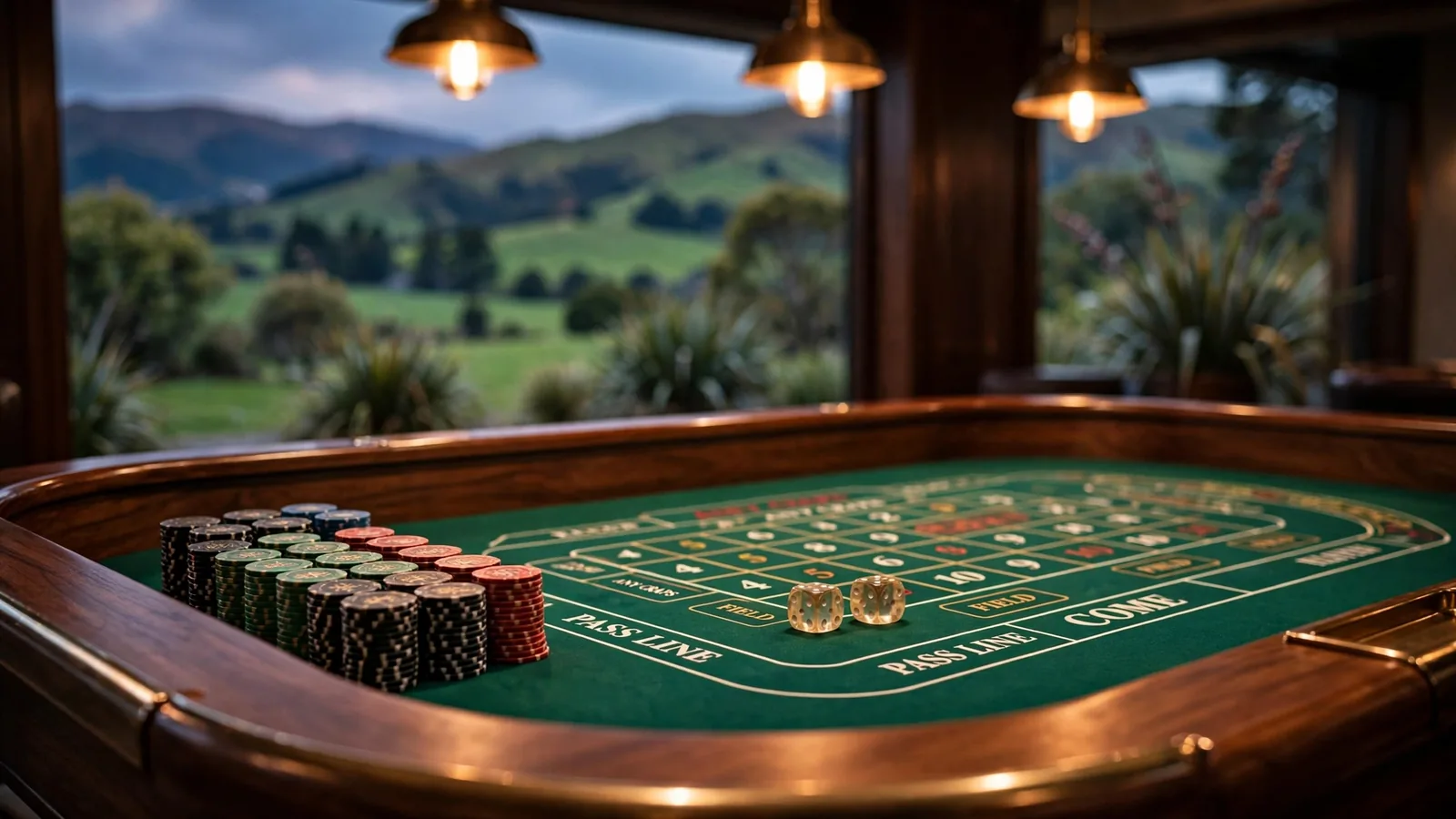
The first phase is the come-out. Once the point has been established, the game enters its second phase, and players may add wagers, including proposition bets. The sequence is important: these additional choices belong to the point phase, not to an undefined interval before the round has taken shape. A craps game, whether played for real money or in a free format, still depends on that underlying division; virtual credits change the stakes, not the table’s basic arrangement.
The layout can make the game appear to be a collection of independent choices. In practice, the two phases give those choices a frame. The line bet qualifies the shooter, while the point phase opens room for further bets. Proposition wagers are among those options, but their presence on a table is not a recommendation to make them. They carry poor odds and a high house edge.
A free craps game can be useful for seeing how the roles and phases fit together without wagering NZD. It cannot turn the table’s conditions into a winning method. Craps involves risk, and extended or excessive gambling can cause harm. Anyone choosing to gamble should set a loss limit in NZD beforehand, keep to it, and stake only money they can afford to lose.
Online Craps, Automated Positions and Free Play
At a physical craps table, play is organised around positions and the people performing their functions. Online, those functions are automated by the game software. The change is more than a matter of replacing felt with a screen: the table’s order no longer depends on a group of people carrying out separate tasks. The interface manages the positions, while players interact with the game through the controls it provides.
Online craps replaces human table positions (like the shooter and dealer) with automated software that manages the game’s choreography and procedure.
That arrangement makes online craps a different kind of social object. A live table gathers attention around a shared surface; an online game translates that arrangement into software. The visible table may preserve familiar roles and markings, but the work behind them is handled digitally. There is less to coordinate in person. The machine keeps the procedure moving.
Free play sits within that same online setting, but it changes what is at stake, not how the table’s positions are operated. Where a site offers a demo version, its virtual credits are for play within the game and cannot be withdrawn or won as cash. They are not NZD, and a balance displayed on screen should not be mistaken for money available outside the game. The distinction is plain, though screens are very good at making unlike things look alike.
A free online craps simulator may therefore resemble a paid game in its interface, while the credits distinguish the experience. That resemblance should not be taken as proof that every feature, table variation or bet is present in demo play. A search for free online craps with a Fire Bet, for instance, does not establish that a particular free version includes that bet. The name alone cannot settle the matter.
Nor does automation make online play consequence-free once real money is involved. Software may handle the table’s positions, but it does not set a player’s personal boundaries. Excessive gambling carries risks, and a virtual interface can make repeated play feel frictionless. Any real-money gambling should be limited to funds that can be afforded to lose; a loss limit in NZD should be set in advance and kept to.
The appeal of playing craps online for fun, without money at risk, is therefore distinct from wagering. One is an interface experience; the other involves financial loss as a possibility. Automation supplies the table’s machinery. It does not supply judgment.
Odds, Pass Line Bets and the Cost of Proposition Bets
Craps offers bets with sharply different costs. Pass Line and Free Odds bets are identified as options with a lower house advantage, while proposition bets carry a high house edge and poor odds. That distinction matters more than the drama of a single roll: a bet can look simple on the layout and still be an expensive way to take part.
A Pass Line bet wins when the come-out roll is 7 or 11, and loses when it is 2, 3 or 12. Other results establish a point, shifting the question to whether that number or a 7 appears first. The rules give the bet a clear shape, but they do not make its outcome predictable. No betting choice turns chance into a dependable system.
Free Odds bets are also described as a lower-house-advantage option. A calculator may help lay out the arithmetic of a contemplated bet, but arithmetic is not a forecast: it cannot tell which number the dice will produce. A lower house advantage is a comparison of costs, not a promise that a player will finish ahead. Even a carefully chosen bet remains exposed to loss.
Proposition bets invite attention because they isolate a particular result. Their poor odds and high house edge deserve equal attention. The table’s most vivid options are not necessarily the most favourable ones. Restraint is less theatrical.
Before playing, set a loss limit in NZD and stick to it. The limit should reflect money that can be lost without affecting essential expenses; only funds that can genuinely be afforded to lose belong at the table. If the limit is reached, play stops. Chasing losses or treating another bet as a way to recover them can turn entertainment into financial harm.
Excessive gambling can affect finances, relationships and wellbeing. Free play may remove the immediate risk of losing NZD, but real-money betting does not inherit that protection. A limit is useful only when it is kept, and no bet—whether on the Pass Line, Free Odds or a proposition—can guarantee a winning result.
Is the pass line a good bet?
Yes. Pass Line bets are described as having a lower house advantage than proposition bets, and adding Free Odds is also recommended as a lower-house-advantage option.
How do I become a better craps player?
Practise in a free demo game to learn the rules and follow how bets resolve without risking money. Focus on recognising the come-out and point phases and how the point and seven determine the Pass Line result.
What are the basic rules of craps?
On the come-out roll, a 7 or 11 wins a Pass Line bet, while 2, 3 or 12 loses it. Any other total from 4 to 10 sets the point; the shooter rolls again until the point or a 7 appears. The Pass Line wins if the point comes first, and loses if 7 comes first.
Written by the editors at Casino Slots Hub NZ.