Baccarat for Real Money in New Zealand: Rules and Status
 Available in US
A guide to baccarat’s bets and rule variations, plus the distinction between international online play and local regulation.

Table of Contents
- Real-Money Baccarat in a Market Mid-Transition
- The Three Bets—and the Hand That Wins
- Card Values, Third Cards, and Baccarat’s Unusual Lack of Choice
- Punto Banco, Mini Baccarat, and Other Rule Variations
- What the Payouts Say About the Bets
- An Online Casino Is Not Automatically a New Zealand Casino
- Playing from New Zealand: The Local Boundary
- Live Baccarat, Where the Dealer Becomes Part of the Room
- What Changed in 2026—and What Was Still Pending
- Baccarat Without a Cash Stake: What the Rules Still Teach
Real-Money Baccarat in a Market Mid-Transition
“Real money” changes the question around baccarat. The game is no longer only a set of cards and fixed procedures; it becomes a wager made through a service whose relationship with the player’s country matters. In New Zealand, those are separate matters. Baccarat can be understood as a casino game, while the status of the site offering it depends on a regulatory landscape that is changing.
That distinction can be easy to miss. A game’s presence on a screen does not make the screen a New Zealand casino, and the familiar look of a digital table says little about who oversees the service. The word “online” describes the route by which the game is delivered. “Real money” describes the stake. Neither term, on its own, answers the question of local regulation.
For a New Zealand audience, that distinction sits inside an unusual market position. There are no online casinos regulated by the state. At the same time, playing at an international online casino is not, by itself, unlawful for someone in New Zealand. These points can coexist, though they do not mean the same thing. The first concerns the absence of a domestic state-regulated casino sector; the second concerns the player’s legal position when using an overseas service.
Choosing a real-money baccarat site in New Zealand means considering what is known about each operator before deciding where to play. This overview highlights the specific licensing or payout information available for each entry.
Payout speed: 1-3 business days Wintino lists a payout speed of 1–3 business days, giving players a stated timeframe to consider when assessing cashouts.
License: Curaçao Gaming Authority, licence no. OGL/2024/165/0185 BitStarz lists a Curaçao Gaming Authority licence, number OGL/2024/165/0185.
License: Malta Gaming Authority, licence no. MGA/B2C/370/2017 Play Grand lists a Malta Gaming Authority licence, number MGA/B2C/370/2017.
License: Tobique Gaming Commission, licence no. 0000091 7Bit Casino lists a Tobique Gaming Commission licence, number 0000091.
License: Tobique Gaming Commission, licence no. 0000064 Neospin lists a Tobique Gaming Commission licence, number 0000064.
License: Tobique Gaming Commission, licence no. 0000002 Ricky Casino lists a Tobique Gaming Commission licence, number 0000002.
License: 07017519840 · Payout speed: 1-3 business days Zotabet lists licence number 07017519840 and a payout speed of 1–3 business days.
Payout speed: 1-3 business days Lamabet lists a payout speed of 1–3 business days, a practical detail to consider when evaluating withdrawals.
License: Malta Gaming Authority, licence no. MGA/B2C/394/2017 N1 Casino lists a Malta Gaming Authority licence, number MGA/B2C/394/2017.
This is why real-money baccarat online cannot be reduced to a question of whether the game is available. Availability is a technical fact: a table or digital game may be reachable. Regulation is a different matter, concerned with which rules apply to the provider and what standing a customer has if something goes wrong. A familiar interface can make those distinctions feel abstract. They are not.
The old casino ritual has always relied on a division of roles. The house presents the game; the player accepts a wager; rules settle what happens next. Online, the house is less visible, often reduced to a logo, a menu and a stream of cards. That smoothness can disguise a basic point: an overseas gambling service does not become locally supervised simply because it can be reached from a New Zealand device.
Nor does the absence of state-regulated online casinos mean that the game itself is forbidden. Baccarat is a form of gambling, but the legal question raised by a New Zealand resident using an international site is not identical to the question of whether a casino is established and regulated in New Zealand. The distinction is worth keeping clear, particularly in a period when the framework for online casinos is shifting.
“Real money” also separates baccarat from a demonstration or practice game. The player is staking funds rather than merely watching how a round unfolds. That changes the consequences of the experience, even though the basic form of the game remains recognisable. The table may be digital, but the wager is not imaginary. Any discussion of rules or formats therefore sits beside another, less theatrical question: what status does the service have in relation to New Zealand?
The answer is not supplied by the game’s name, its language settings or the appearance of a dealer on screen. Nor is it supplied by the fact that New Zealand residents may use international casino sites without that act itself being illegal. Those details describe access and the player’s legal position, not local government oversight. A border can be legally significant even when it is practically invisible.
That is the mid-transition condition in miniature: baccarat remains baccarat, while the surroundings in which it is offered are being redefined. For the player, the phrase “real-money baccarat” points both to a wager and to a service relationship. The cards are only one part of the arrangement. The other is the jurisdiction behind the screen.
A small but consequential distinction.
The Three Bets—and the Hand That Wins
Baccarat gives a player three places to put a wager: Player, Banker or Tie. The names can suggest a contest between a customer and a dealer, but they identify the two hands on the table. A wager on Player backs that hand; a wager on Banker backs the other. Tie is the third possibility, for a round in which neither side finishes ahead.
Baccarat targets a value of nine; the hand that finishes closest to this target wins the round.
In standard baccarat, the choice comes before the cards are dealt. That order matters. The wager is not a response to a hand already visible, nor a decision about how to play one. It is a small declaration of allegiance made before the round reveals which side, if either, will come closest to the game’s target.
The target is nine. The hand nearer to nine wins, so the question is not which side holds more cards or appears more imposing, but which finishes nearer that point. A Player wager succeeds when the Player hand is the closer one; a Banker wager succeeds when the Banker hand is closer. If the two hands finish level, the result is a Tie.
That simple arrangement creates an odd little theatre. The labels carry the air of a social hierarchy: Player on one side, Banker on the other, and a third bet for a draw that refuses the contest. Yet the person placing the wager is not choosing between their own hand and the house’s hand. Both are dealt as parts of the same round. The bet concerns which named position will prevail, not who gets to direct the cards.
This is why baccarat can feel unusually spare. Before the deal, there is a choice; after it, the game’s result belongs to the hands. The player’s role is to select an outcome, not to steer one. A wager on Banker is not a claim to be the banker, any more than a wager on Player means that the customer will hold the Player cards. The names are labels for the contest, not job titles bestowed on whoever clicks.

The three options also give the round a clean narrative. One side may finish nearer to nine, or the hands may end level. There is no fourth destination hidden behind a complicated menu of outcomes. A person learning to play baccarat online for money can therefore understand the central decision before learning anything about the dealing procedure: choose the hand expected to finish closer to the target, or choose the possibility that neither will finish ahead.
The Tie option is easy to understand as a description of an outcome, though that does not make it identical in character to backing either hand. It asks for the round to resolve without a winner between Player and Banker. In ordinary language, a tie is not a side. Baccarat makes it one of the available wagers. That neat conversion of a stalemate into a choice is part of the game’s tidy design—and a reminder that the table is organised around outcomes, not personalities.
For a first encounter with real-money baccarat, the useful distinction is between choosing a wager and playing a hand. The wager is chosen in advance; the hands then compete under the game’s procedures. The word “Player” can make that boundary seem less clear than it is, especially in an online display where the two sides appear as buttons or boxes. But the player at the screen is selecting a position. They are not taking over the hand bearing that name.
The aim, then, is modest in wording and exact in consequence: back Player, back Banker, or back a level result, with victory determined by closeness to nine. No tactical speech is required to describe the basic wager. The choice is brief; the meaning of the labels is the part worth keeping straight. Baccarat gives the player a say in which outcome to support, then leaves the hands to settle the matter. A narrow role, clearly drawn.
- Select a wager before the cards are dealt
- Back the hand expected to finish closer to nine
- Expect to steer the hand once the round begins
- Confuse choosing a wager with playing the hand
Card Values, Third Cards, and Baccarat’s Unusual Lack of Choice
Baccarat’s arithmetic is deliberately ungrand. The aim is not to build the largest total, but to compare the last digit of each hand’s sum. When cards add up to a total beyond a single digit, the earlier digits fall away; only the final one counts. The hand’s apparent size can therefore be misleading. A high sum does not necessarily mean a high baccarat value.
Numbered cards retain their printed value. An ace counts as one, while a ten and each face card count as zero. Suits have no bearing on the calculation or on which hand wins. The cards are reduced to arithmetic, then the arithmetic is reduced again. It is a small, tidy system, with little room for interpretation.
That simplicity can make the deal seem more active than it is. In the standard form commonly played online, the cards are dealt and the drawing rules determine whether either hand receives another card. Players do not decide how to play the hands. Their role is to follow the totals as they emerge, not to request a card, stand, or alter the dealer’s procedure.
The Player hand’s progress matters to what happens next: baccarat includes rules under which the Banker may draw a third card after the Player receives one. That sequence is not a prompt for the person at the table to make a strategic choice. The Banker’s action is governed by the game’s rules, not by a player’s reading of the moment. The cards may look like an invitation to improvise; the procedure declines it.

This is one reason baccarat feels unlike games in which a player weighs each new card against a personal decision. A hand can change, but the person wagering does not direct that change. The distinction is important when watching an online round: the visible deal is not a negotiation between player and dealer. It is a sequence carried out according to fixed drawing rules.
The calculation also explains why the comparison is not about collecting the most valuable cards in the ordinary sense. A hand’s raw sum is only an intermediate step. Once the final digit is taken, the baccarat value is set, and suits have contributed nothing to the result. The same card can be part of a larger raw total without making the hand stronger in the way a conventional high-card game might suggest.
For anyone learning how to play real-money baccarat online, this is the useful mechanical distinction: understand how the total is counted, then let the prescribed deal run. The rules determine whether a third card appears; the participant does not choose it. There is less decision-making than the ceremony of the cards might imply.
The absence of choice is not an oversight. It is part of the game’s design, separating the wager from control over the hands. The cards are exposed one after another, but the procedure has already decided what can happen next. Quietly, the rules do the playing.
Baccarat Value Calculation
Add the values of the cards in the hand, counting aces as one and face cards or tens as zero.
If the total is beyond a single digit, the earlier digits fall away.
Only the final digit counts as the hand’s baccarat value.
Punto Banco, Mini Baccarat, and Other Rule Variations
The name “baccarat” can describe games with different arrangements around the same central ritual. In online casinos, that distinction matters less as a question of atmosphere than of who handles the cards, whether the procedure leaves room for a player’s choice, and how a particular table treats a Banker win.
Punto Banco is the most common baccarat variant worldwide and the standard form found online. Its name points to the two hands at the centre of the game: Player and Banker. Despite those labels, neither hand belongs to a participant making strategic decisions. Players select a betting position; the dealing of the hands follows fixed rules. Online, this stripped-back structure makes Punto Banco the reference point against which other versions are described.
Mini baccarat keeps close to that structure but changes the scale and handling. A specialist review describes it as a lower-stakes version played at a smaller table, with the dealer always acting as Banker and players not permitted to touch the cards. The smaller setting changes the social choreography: the table becomes less of a stage for participants and more of a controlled dealing space. The rules also vary in some details, though the label alone does not specify exactly which changes a particular table uses. Formats are not contracts with identical clauses.
Other named versions make more pointed alterations. A specialist review of European baccarat describes a variation in which a Player hand that begins with five may be given a choice about drawing one more card. That differs from the automatic procedures associated with Punto Banco, where the dealing rules—not a player’s judgement—settle whether another card is taken. The distinction is narrow, but it changes where agency sits: a choice that is normally absent appears at a defined moment.

Super 6 changes the treatment of Banker wins. A specialist review describes it as a no-commission format, with a Banker hand totalling six paid at half the ordinary even-money level. The format therefore removes one feature of conventional commission arrangements by attaching a special condition to that particular result. This is not merely a new name on the same table; the stated exception changes how the Banker side is settled.
These variations should not be collapsed into a single universal rulebook. “Baccarat” identifies a family of games, while the table’s version determines the precise procedure. Punto Banco provides the common online template; Mini baccarat alters the setting and handling; European baccarat introduces a limited decision in the account cited; and Super 6 changes a Banker payout condition. The distinctions are useful before play begins, because a familiar label does not guarantee identical rules.
The differences also reveal something about the game’s design. Baccarat is often presented as a contest of nerve, yet its standard online form gives players little control over the dealing itself. Variants add a small amount of human involvement, alter the table’s scale, or revise a settlement condition. They do not turn the game into a different species so much as adjust the boundary between ceremony and calculation. A small boundary, but a real one.
What the Payouts Say About the Bets
A baccarat payout can look generous while concealing an expensive wager. The useful comparison is not simply how much a winning bet returns, but how that return sits alongside the house edge: the mathematical advantage built into the game over time. The figures distinguish the three choices more sharply than their names do.
Returns one to one with a house edge of 1.24%.
Returns 0.95 to one with a lower house edge of 1.06%.
Returns eight to one but carries a high house edge of 14.36%.
A winning Player bet pays one to one, with a house edge of 1.24%. A winning Banker bet pays 0.95 to one, while its house edge is lower, at 1.06%. The Banker return is therefore smaller when the wager wins, but the statistical cost attached to that choice is also slightly lower. A larger payout is not, by itself, evidence of better value.
That difference is easy to miss because baccarat puts the bets beside one another on the same table. They look like neighbouring opinions about a hand, not separate financial propositions. Yet the payout schedule makes the distinction plain: the Player option returns the full one-to-one amount, while the Banker option gives less than that and carries the lower edge. Each figure matters; neither should be read alone.
The house edge is not a promise about what happens to an individual stake. A hand can win or lose without following the long-run comparison. The percentage instead describes the built-in mathematical disadvantage attached to a wager across repeated play. It does not say that a particular session will match that rate, or that a winning streak changes the underlying terms.
The Tie bet is the conspicuous outlier. Its payout is eight to one, but its house edge is 14.36%, far above the figures for either side bet. That larger return is the bright label on a much less favourable proposition. It does not compensate for the substantially greater edge. For that reason, the Tie bet is not a sensible recommendation for real-money play.

The contrast is part of baccarat’s old economy of attention: a compact set of choices, each made to look legible, with the financial differences tucked into the settlement terms. A high payout attracts the eye; the house edge asks what that attraction costs. In this case, the most dramatic number belongs to the least favourable bet. A neat little trap.
For anyone comparing online baccarat for real money, these figures offer a more useful measure than the apparent drama of a payout. The Banker bet has the lowest house edge among the three stated options, followed closely by the Player bet. The Tie bet sits far behind them. That comparison does not make either side bet a guarantee of favourable results, nor does it remove the uncertainty of individual outcomes. It simply shows how the game prices each choice.
The distinction between payout and edge is worth keeping intact. Payout describes what a winning wager earns under the stated terms; house edge describes the casino’s mathematical advantage over time. Looking at one without the other leaves half the bargain unseen. In baccarat, the smaller Banker payout comes with the more favourable edge, while the Tie’s eye-catching return comes with the steepest cost.
An Online Casino Is Not Automatically a New Zealand Casino
The word “online” describes where a game is played, not which country’s rules govern its operator. A baccarat table reached through a screen may feel close at hand; that does not make the site part of New Zealand’s regulated gambling system. The distinction matters because a familiar currency, local players or a page that reads smoothly in English cannot establish domestic oversight.
New Zealand’s locally regulated online gambling is limited to specific entities such as Lotto NZ and TAB/Betcha.
New Zealand gambling is governed by the Gambling Act 2003. Within the online landscape, the locally controlled options are a narrow group: Lotto NZ, Class 3 gambling, and TAB/Betcha. That list is not a catalogue of online casinos. It describes different forms of gambling, with distinct purposes and structures, rather than a general permission for locally based companies to provide casino games over the internet.
The official regulatory picture is narrower still when stated by the bodies and services named in it. Lotto NZ operates the state lottery, while the New Zealand Racing Board, through TAB, is the other online gambling service identified as regulated by the New Zealand Government. Class 3 gambling belongs in the account of locally controlled online gambling, but it should not be mistaken for a government-run baccarat room. Categories matter. So do the institutions behind them.
That can be easy to miss when a search for real-money baccarat online returns sites that look alike at first glance. A casino interface offers its own small civic theatre: a lobby, rules, payment labels, a dealer’s image, perhaps a flag in the footer. Yet presentation is not jurisdiction. A service may be available to someone in New Zealand without being a New Zealand-regulated casino; the two descriptions answer different questions.
The difference also reveals something about the country’s approach to gambling. The local online framework has historically centred on specific public or defined forms of wagering, rather than a broad domestic casino market. Lotto NZ and TAB sit within recognisable institutions; Class 3 is a legal category, not a synonym for casino play. The result is a market in which “online gambling in New Zealand” and “an online casino regulated in New Zealand” cannot be used interchangeably.
For baccarat, that distinction is more than a label. The game itself can be the same whether its cards are dealt at a physical table or shown on a screen. The regulatory relationship is not. A site’s game rules explain how a hand is played; they do not say which New Zealand institution, if any, supervises the service. A polished table is not a licence.
This is why the phrase “New Zealand online casino” can mislead when it is used as a loose description of any casino site accessible from the country. Local control is limited, and the recognised services are not a roster of casino operators. The useful distinction is plain: online access describes the channel; regulation describes the authority behind it. Those are separate facts, not interchangeable assurances.
Playing from New Zealand: The Local Boundary
For someone in New Zealand, playing baccarat at an international online casino is not, by itself, illegal. That answers a narrow legal question: the player does not incur a fine or criminal prosecution simply by placing a wager with an offshore site. It does not turn the site into a New Zealand casino.
The distinction lies between the person at the screen and the business on the other side of it. A game may be available from a New Zealand connection while the service is operated abroad, beyond the ordinary reach of domestic oversight. Access is not the same thing as local approval. Nor does the absence of a player offence amount to a promise that a dispute will be handled under New Zealand rules.
No Domestic Recourse
Offshore online casinos are not licensed by a New Zealand regulator, meaning customers have no domestic government recourse if a dispute arises.
That boundary matters most when something goes wrong. In the period before the new domestic framework, offshore online casino services were not licensed or supervised by a New Zealand regulator, and customers had no domestic government recourse against them. The fact that a site accepts a wager from a Kiwi gamer cannot supply that missing protection. A screen can look local without being local in any legal sense.
The law therefore separates two ideas that are often folded together in casual conversation: whether a resident may play, and whether a provider is regulated at home. The first is not prohibited merely because the casino is international. The second depends on the provider’s legal position, not on the player’s address, the currency displayed, or the familiarity of the interface. None of those features establishes New Zealand oversight.
This is a restrained boundary, not a seal of approval. It leaves room for a person to access overseas gambling while making clear that local legality does not carry across the connection as a protective wrapper. Online baccarat for real money can be reachable from New Zealand; that fact alone says little about who would answer a complaint, or under which rules.
A small legal distinction. A large practical one.
Live Baccarat, Where the Dealer Becomes Part of the Room
Online baccarat can be presented with a live dealer, rather than only through a digital interface. That change is less about the wager than about the company kept while it is made: a human presence, a visible table and the small intervals of action that software can otherwise compress or remove.
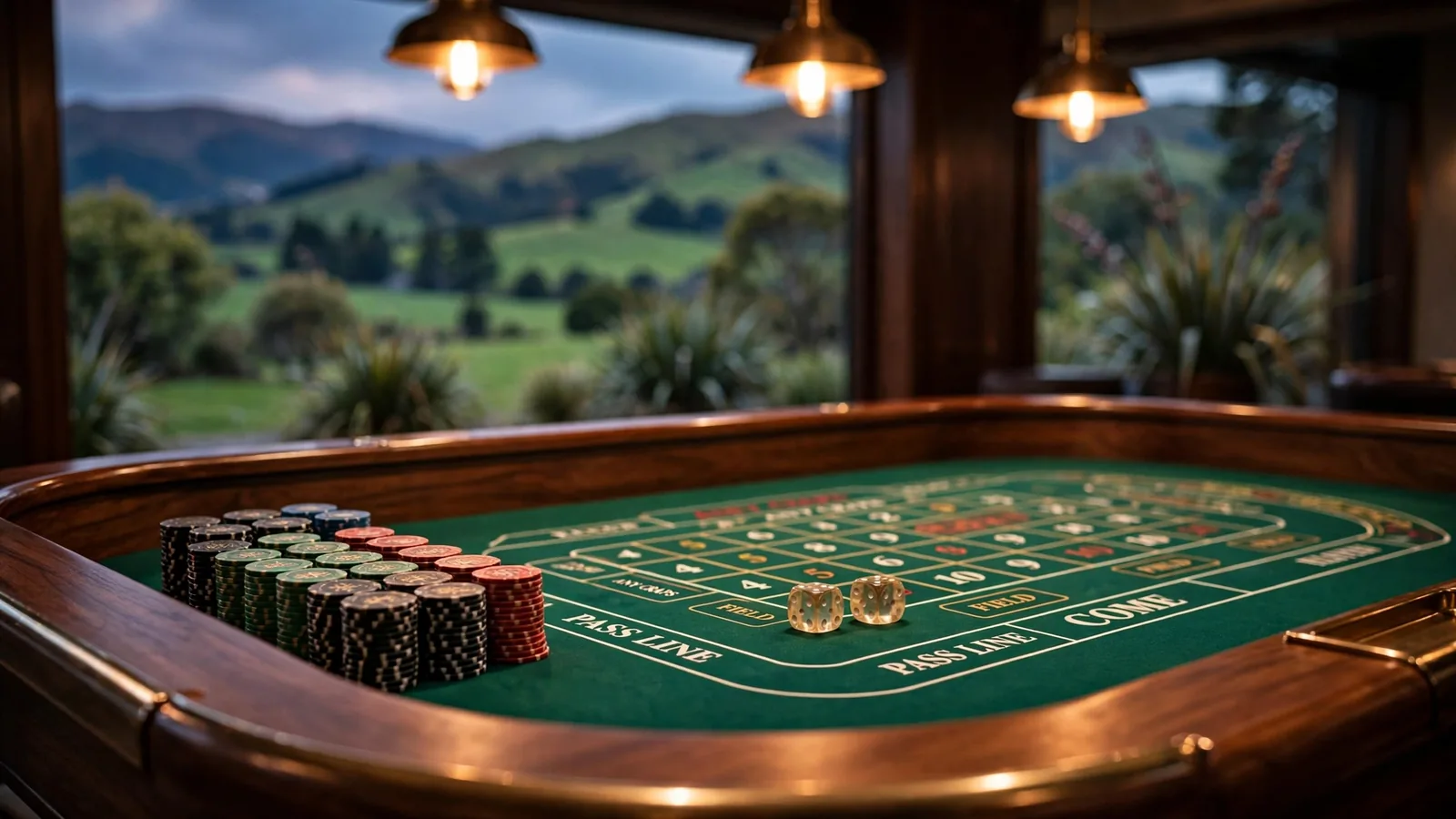
The dealer gives the game a room, even when the room is a camera’s view on a screen. Cards are handled in real time, and the round unfolds at the pace of the table rather than at the click of a button. For some players, that visible procedure is part of the attraction. It turns a solitary screen into something resembling a shared ritual, though the other people at the table may remain no more than names or images.
There is a social idea buried in that arrangement. Casino games have long borrowed the theatre of a public table: a dealer, a marked surface, a sequence everyone can watch. The live version carries that staging into online play. It does not make the game a conversation, but it restores a human interval between decision and result. A pause can feel like atmosphere. It can also feel like waiting.
That contrast is not merely theoretical. A specialist casino review has described live play as comparatively dull beside faster online action. It is an observation about pace, not a universal verdict: the very delay that frustrates one player may be what another values. In a game whose procedure is largely fixed, the dealer’s presence supplies texture rather than control.
Live baccarat online for real money therefore joins two different habits of play. One seeks immediacy; the other makes room for the visible handling of a round. Neither format changes the basic appeal of baccarat so much as the way time is spent around it. The screen becomes less like a button and more like a window onto a table.
A quieter spectacle.
Live Baccarat Experience
- Provides a human presence and visible table via a camera stream
- Rounds unfold at the pace of the table rather than by button clicks
- Restores a human interval and atmosphere to the online experience
What Changed in 2026—and What Was Still Pending
For anyone looking at real-money baccarat in New Zealand, 2026 marked a change in the legal framework, not the arrival of a completed licensing system. The Online Casino Gambling Act 2026 took effect on 1 May, establishing a domestic route for licensing online casino gambling. The date matters; so does the distinction between a law beginning and licences being available.
The Act gave the country a structure for regulating online casino services from within New Zealand. But the framework did not mean that licensed online casinos appeared as soon as it commenced. Licences were not expected to be issued until 2027. In other words, the legal machinery had started, while the stage at which operators could hold licences remained ahead.
That interval can make a year in a page title seem more decisive than it was. “2026” names the point at which the new law came into force; it does not, by itself, establish that an online casino offering baccarat was already licensed under the new system. The calendar changed before the licensing picture was complete.
There is a familiar administrative pattern here: legislation draws the boundary, then the practical system takes time to occupy it. In gambling, that gap is more than a matter of paperwork. A licence is the instrument through which a regulator can oversee a provider under the new regime; the expectation of future licences is not the same thing as having them in hand. The distinction is less dramatic than a launch announcement, but more useful.
So the 2026 change should be read precisely. From 1 May, the Act was in force and a domestic licensing system had been established. The licences themselves were still expected in 2027. For online baccarat, those are separate points on the same timeline, not one event described twice.
A statute can arrive on a date. A regulated market takes longer.

Baccarat Without a Cash Stake: What the Rules Still Teach
A no-cash round can make baccarat’s peculiar division of labour easier to see. In Punto Banco, the player chooses where to place a wager: Player, Banker or Tie. The player does not direct either hand. Once the wager is set, the game’s rules govern what happens next.
That distinction is the lesson. Baccarat offers a choice at the edge of the round, then withdraws choice from its centre. The cards are not a puzzle for the person at the screen to solve, and there is no tactical command to issue when a hand develops. The apparent drama belongs to the unfolding result; the player’s role is deliberately narrow.
A practice mode, if a particular game provides one, could help make that structure familiar without putting money at stake. It would not, by itself, teach a winning method. Repeated rounds can show how the format proceeds, but repetition does not turn a fixed procedure into a skill contest or give the player control over the hands. No magic in the button.

This makes baccarat online without money less a rehearsal for clever play than a way to understand what the game asks of its participants. The central question is not how to influence the deal. It is whether to take part in a round whose decisions are mostly made elsewhere: by the rules, the cards and chance.
That can be a useful distinction before real money enters the picture. A person who expects a strategy to steer each hand may find Punto Banco strangely impersonal. Someone interested in its ritual may see the appeal: a wager is declared, the procedure takes over, and the table arrives at an outcome without asking for further judgement.
The format’s restraint is part of its character. In many games, participation means choosing actions as events unfold. Here, participation means choosing a position and then watching. A no-stake setting, where available, can reveal that difference; it cannot alter it. The rules remain the rules, whether a round carries a cash wager or none at all.
What is the difference between Baccarat and Punto Banco?
Baccarat is the broader game, while Punto Banco is its most common variant and the standard version at online casinos. In Punto Banco, players bet on Player, Banker or Tie but do not control how the hands are played.
Is it legal to play baccarat in New Zealand?
Yes, it is not illegal for New Zealand players to use international online casino sites. However, New Zealand has no state-regulated online casinos, so using an overseas site does not mean it is overseen by the New Zealand government.
Is baccarat a game of skill or luck?
Baccarat is primarily a game of chance: players choose which outcome to bet on, while the hands follow drawing rules and cannot be controlled by the player.
Why is Banker the best bet in baccarat?
The Banker bet has a lower house edge—about 1.06%, compared with about 1.24% for Player. It still does not guarantee a win, and Banker wins typically pay 0.95 to 1.
Created by the ”Casino Slots Hub NZ” editorial team.