French Roulette in New Zealand: Rules and Odds
 Available in US
A free game can clarify the wheel, layout and French rules, but it cannot reveal what the next spin will bring.
Table of Contents
- A Free Spin Is a Lesson, Not a Forecast
- French Roulette Online in New Zealand: The 2026 Context
- The Live Table: Wheel, Layout and Dealer
- French Bets, Zero and the Two Rules That Change the Turn
- What the Odds Allow—and What They Do Not
- French and American Roulette: One Extra Pocket Matters
- Payouts, Even-Money Bets and Playing for Fun
- Called Bets Belong to the Wheel, Not the Felt
- Roulette, Blackjack and the Limits of an Edge Comparison
- Gold and Lightning: A Name Is Not a Probability
A Free Spin Is a Lesson, Not a Forecast
A free French roulette game is useful for one modest purpose: learning what the table is doing before money enters the picture. The wheel turns, a ball settles, and the result appears without a stake at risk. That removes one pressure, though not the need to pay attention. Practice can make the game’s vocabulary and sequence less unfamiliar; it cannot reveal what the next spin will bring.
French roulette shares its single-zero wheel arrangement with European roulette. Its distinction lies in additional rules, including La Partage and En Prison. A free version can help a new player notice that the label “French” is not merely decorative: the game may handle certain bets differently when zero appears. The details belong to the rules displayed by the particular game, which should be read rather than inferred from its name.
That is a useful lesson in itself. A practice session allows someone to follow the animation, find the controls and watch how a chosen wager is represented, without converting confusion into a financial loss. It also gives time to notice which version is on screen. A table marked French roulette may present special rules that are not part of every roulette game, while a familiar-looking wheel does not guarantee that every option works identically.
The point is not to rehearse a “system”. It is to understand what the interface means. A player can place a pretend wager, wait for the outcome and then check whether the display reflects the rules described on the table. If the game offers a written explanation of La Partage or En Prison, the practice setting can make that explanation easier to follow: the rule is seen in the course of play, rather than encountered for the first time when a real stake is involved. No elaborate strategy is required. Curiosity is enough.
Free French roulette online can also reveal the difference between knowing a rule and remembering it under the rhythm of a game. Someone might understand a description of a special rule, then overlook its condition while watching a spin. Repeating the sequence without staking money lets the condition become familiar. The exercise is closer to learning a board’s controls than to training for a predictable result.
The free format does not need to imitate every aspect of a live table to be useful. Its value is narrower: it offers a low-pressure way to observe a single-zero game and become acquainted with its special treatment of particular bets. It does not establish how a person will feel when real money is involved, and it does not turn a run of practice outcomes into a guide. A simulated win can be vivid; as evidence, it is empty.
This is where practice can quietly mislead. A short session may produce a pleasing sequence, or an irritating one. Neither sequence has authority over the next spin. Roulette outcomes are independent: the results already shown do not change the probability of what follows. A streak in a free game is not a message from the wheel, and a run of missed guesses does not make a chosen number “due”. The screen remembers. The wheel does not.
That distinction matters because practice makes patterns easy to see. A cluster of results can look like a rhythm, especially when the animation repeats and the history panel keeps a record. But a record is a description of what has happened, not a forecast of what is about to happen. Free play can teach where to find that history and how to read the game’s display; it cannot make the history predictive.
Attention: Roulette outcomes are independent. A streak in a free game is not a message from the wheel, and a run of missed guesses does not make a number “due.”
There is no need to treat free play as a test of nerve or a rehearsal for guaranteed success. It is simply a chance to learn the language of one roulette variant: the single-zero wheel, the table’s labels, and the presence of rules such as La Partage and En Prison. The practical benefit is familiarity. The limit is just as important: no practice outcome can promise a future result, whether the game is free or played for money.
For anyone moving from a free version to real-money play, the change is not merely a different button. Every real-money wager can lose, and no betting system removes that possibility. Money should never be risked beyond what can be afforded to lose. Practice can reduce uncertainty about the interface and the rules. It cannot reduce the wheel’s uncertainty.
A lesson, not a forecast.
French Roulette Online in New Zealand: The 2026 Context
Finding French roulette options in New Zealand for 2026 calls for checking what information is available about each operator before choosing. Use these brief verdicts as a starting point, and verify that French roulette is available to you.
Payout speed: 1-3 business days Wintino lists a payout speed of 1–3 business days, a useful detail for readers weighing payment timing.
License: Curaçao Gaming Authority, licence no. OGL/2024/165/0185 BitStarz lists a Curaçao Gaming Authority licence, number OGL/2024/165/0185.
License: Malta Gaming Authority, licence no. MGA/B2C/370/2017 Play Grand lists a Malta Gaming Authority licence, number MGA/B2C/370/2017.
License: Tobique Gaming Commission, licence no. 0000091 7Bit Casino lists a Tobique Gaming Commission licence, number 0000091.
License: Tobique Gaming Commission, licence no. 0000064 Neospin lists a Tobique Gaming Commission licence, number 0000064.
License: Tobique Gaming Commission, licence no. 0000002 Ricky Casino lists a Tobique Gaming Commission licence, number 0000002.
License: 07017519840 · Payout speed: 1-3 business days Zotabet lists licence number 07017519840 and a payout speed of 1–3 business days.
Payout speed: 1-3 business days Lamabet lists a payout speed of 1–3 business days.
License: Malta Gaming Authority, licence no. MGA/B2C/394/2017 N1 Casino lists a Malta Gaming Authority licence, number MGA/B2C/394/2017.
The phrase “French roulette in New Zealand” sits inside a legal transition, not a settled domestic casino market. The Online Casino Gambling Act 2026 took effect on 1 May 2026, establishing New Zealand’s first domestic licensing system for online casino gambling. The change is substantial, but it does not mean that the full regime is already operating.
The transition runs from 1 May to 1 December 2026. Providers that were already serving people in New Zealand before the Act began may continue during that window. By its end, they must have applied for a licence to keep operating; the full licensed system is expected to be in place in 2027. The Act also provides for unlicensed operation to become an offence around mid-2027. These dates mark stages of the transition, rather than a claim that every online casino is already licensed.
The division of regulatory work has two parts. The Department of Internal Affairs is New Zealand’s primary gambling regulator and oversees the online casino licensing framework. The Gambling Commission hears and decides casino licence applications, issues online casino licences and approves changes to licence conditions. The Gambling Act 2003 did not permit online casinos to be based in New Zealand, and domestic online casinos remain prohibited. The newer framework concerns licensing providers of online casino gambling; it does not make New Zealand-based online casinos lawful.
Before the 2026 Act, online casino gambling supplied from overseas had no New Zealand regulator licensing or supervising it. A customer using an offshore website in that period had no domestic government recourse. The new framework changes that institutional picture in stages. For French roulette online, the relevant question in 2026 is therefore not only which game is offered, but also where the provider sits in the transition and whether it has made the required application.
Bonuses add a separate set of conditions. Operators may advertise offers with eligibility rules, wagering requirements, expiry dates, limits on which games contribute towards wagering, and restrictions on withdrawals. The headline offer is only one part of the bargain. Bonus money must be wagered 50 times within 30 days; winnings from free spins must be wagered 50 times within 7 days. A withdrawal request voids any active or pending bonuses. Those terms can matter more than a bright banner suggests.
The timing and game-contribution rules can shape whether an offer is usable at all: an eligible customer may still face a restricted period, qualifying games, or a deadline. A bonus balance is not the same thing as withdrawable cash. And requesting a withdrawal can bring active or pending bonus terms to an end, so the point at which a customer asks for funds may affect the offer’s status. Terms vary by promotion and operator; the conditions attached to a particular offer are the ones that govern it.
Legal Status
Domestic online casinos remain prohibited in New Zealand. The 2026 framework concerns licensing providers of online casino gambling, not making New Zealand-based online casinos lawful.
That distinction belongs in any account of online French roulette in New Zealand. A table game may be presented as entertainment, while the account around it is governed by a licence, promotional conditions and withdrawal rules. The new licensing system is intended to place online casino providers under domestic oversight, but its transition means that the legal status of a provider cannot be inferred from the game’s name or language. French roulette is a format, not a regulatory credential.
A label is not a licence.
The Live Table: Wheel, Layout and Dealer
A live French roulette table has two geometries in view. The wheel carries the numbered pockets around its rim; the betting layout is the green surface beside it, where the same numbers are arranged in rows and columns. They belong to one game, but they are not the same map. The distinction becomes visible whenever a dealer names a group of numbers by their places around the wheel.
The French wheel has the single-zero arrangement also used in European Roulette. Its French identity comes with rules such as La Partage and En Prison, rather than a separate sequence of pockets. At a live table, that means the wheel itself may look familiar to anyone who has seen a European-style game, while the felt, signage and dealer vocabulary signal the French presentation.
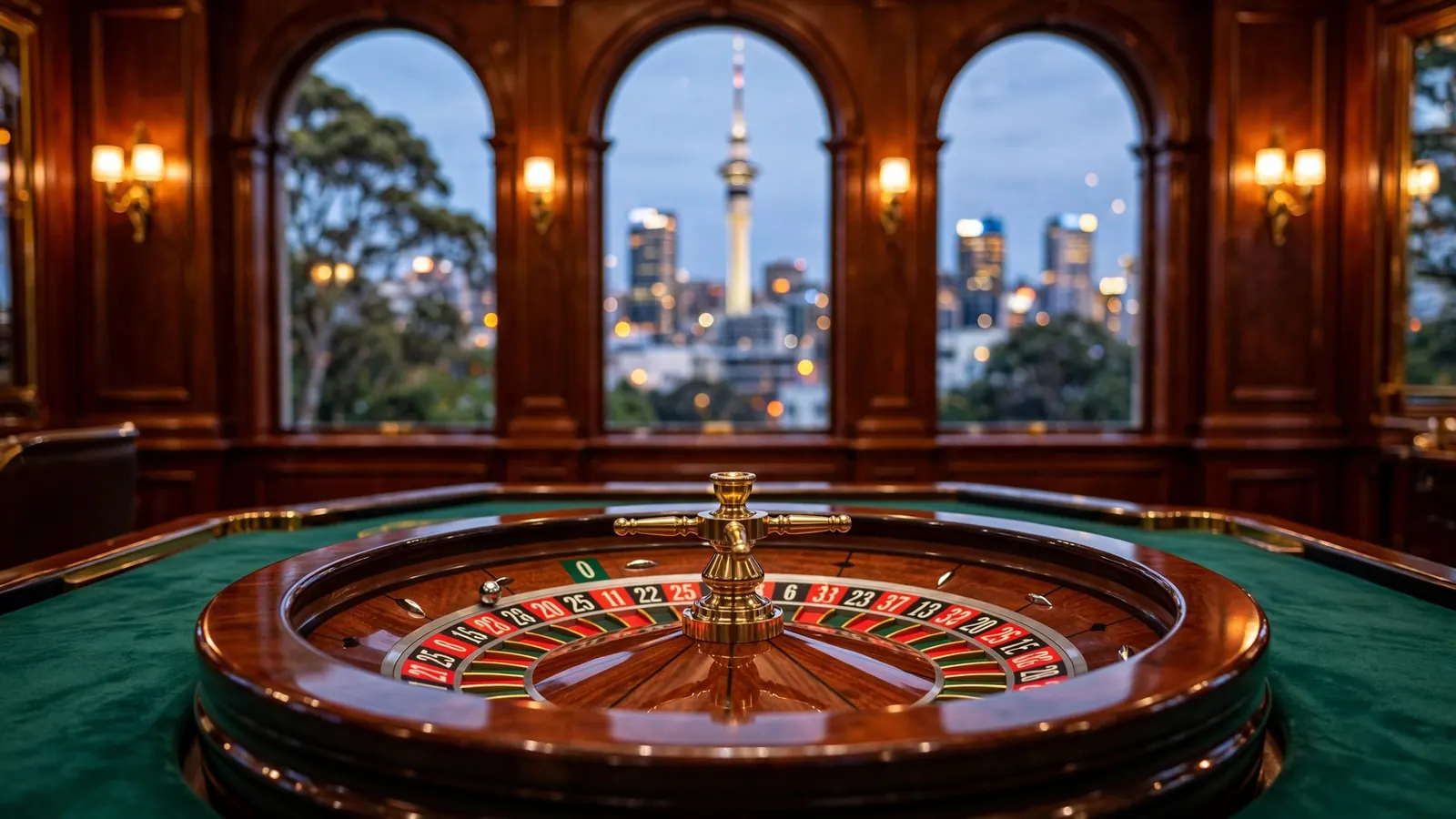
The layout is often the first thing a camera makes legible. A streamed table may show the wheel at one side of the frame and the betting area at the other, with the dealer moving between them. The screen is not merely decoration around a digital board: it gives the spin a visible setting, and makes the dealer’s gestures part of how the game is read. A French roulette online game may preserve this division even when a player sees it through a screen rather than across a room.
That separation matters because table positions and wheel positions do not correspond. Numbers printed together on the felt are grouped for betting convenience; numbers adjacent on the wheel form a different neighbourhood. When a dealer announces a called bet, the grouping refers to the wheel, not to a neat patch of felt. The call may therefore sound spatial while pointing to a different kind of space from the one visible in the betting layout.
There is an old, practical logic behind the split. The wheel is the mechanism that produces the result; the layout is a working surface for placing and recording wagers. Dealers need to move between those two systems without confusing one for the other. The numbers may be identical, but their arrangement answers different questions: where a number sits on the wheel, and where a bet can be placed on the table.
Table positions and wheel positions do not correspond. Numbers grouped for betting convenience on the felt form a different neighbourhood than those adjacent on the wheel.
In a physical room, the dealer’s voice and hands help bridge the gap. In a streamed game, camera framing performs some of that work, though the viewer still has to distinguish the circular wheel from the rectangular betting area. The presentation can feel more social than an automated table, where the spin may proceed without a dealer visibly guiding the action. “Live” describes the table format; it does not alter the wheel’s basic arrangement.
Automated roulette can be encountered in a live-casino setting too, but the label alone does not establish precisely how a particular table is operated. The useful distinction is visual and practical: a dealer-led stream foregrounds a person managing the table, while an automated presentation foregrounds the machine and the layout. Neither makes the felt a diagram of the wheel.
A French roulette demo can be useful for recognising those parts of the scene without placing a stake. On a phone or other small screen, the wheel and layout may appear together but at reduced scale; on a desktop display they may have more room. The interface can change with the device, while the underlying distinction remains. The felt is where bets are arranged. The wheel is where the numbers travel.
That is the table’s small act of translation: a dealer speaks in the language of wheel positions, while the layout offers a practical place to mark a choice. Two maps. One spin.
French Bets, Zero and the Two Rules That Change the Turn
A French roulette bet begins with a choice on the betting layout: a number, a group of numbers, or an outside category. The layout’s labels do the practical work. A straight-up bet marks one number; other positions cover combinations or broad groups. Outside bets include red or black, odd or even, and low or high numbers. These are called even-money bets because a winning bet returns an amount equal to the stake, as well as the stake itself.
That familiar arrangement is not the whole story. French roulette’s distinctive treatment of zero concerns only even-money outside bets. A bet on a single number, or another bet placed inside the layout, does not qualify for La Partage or En Prison under these rules. Nor do the rules alter a round when any number other than zero lands.
The distinction is easy to overlook at a busy table: the colour bet and the number bet may sit only a short distance apart, but zero treats them differently. The placement determines which rule can apply.
When zero lands: La Partage
La Partage means that half of the stake on an eligible even-money outside bet is returned when zero appears; the other half is collected. The bet does not win, but the whole stake is not lost either.
For example, a red bet remains an eligible outside bet whether red or black is chosen. If zero lands, La Partage returns half the stake and takes the rest. The same treatment applies to eligible odd/even and low/high bets. It is a specific response to zero, not a general refund attached to every wager on the table.
The name is often rendered as “sharing” in English, a useful description of the split, though the table’s printed rules are what determine how a game handles a turn. French roulette may use La Partage, En Prison, or a stated set of rules; the label French alone is not a substitute for checking the table conditions.
- Distinguish even-money outside bets from other wagers
- Check if the table applies La Partage or En Prison
- Assume a red bet is the same as a bet on a red number
- Rely on a betting system to make results certain
When zero lands: En Prison
En Prison handles the same eligible outside bets differently. Instead of returning half the stake immediately, the table carries the entire bet forward to the next spin. The stake is held in place: neither available for another wager nor yet collected.
If the next spin wins for the original even-money bet, the stake is returned, but no additional winnings are paid. If that spin loses, the stake is collected. The player has not made a fresh choice on the held stake; the original bet remains subject to its prison rule.
The two names describe different fates for the same kind of wager. La Partage divides the stake at once. En Prison delays its resolution until another spin. Either rule is relevant only after zero and only for an even-money outside bet.
Reading the bet before the spin
A simple way to learn French bets is to separate the decision into two parts: first identify what the wager covers, then identify whether it is an outside even-money bet. That keeps the special zero rule from being confused with the ordinary result of a number or inside bet. The chip’s location matters; a red bet is not the same wager as a bet on a red number.
No betting system can make a roulette result certain or turn a sequence of losses into a guaranteed recovery. A real-money bet can lose, and roulette outcomes are random. The rules change what happens to certain stakes when zero lands; they do not control which pocket the ball reaches. Every wager belongs to that uncertainty. Risk no more than can be afforded to lose.
The practical point is modest, but important: before placing a French roulette bet, distinguish an even-money outside choice from every other bet, then know whether the table applies La Partage or En Prison. Zero is one pocket. Its consequences are not one-size-fits-all.
What the Odds Allow—and What They Do Not
La Partage and En Prison change the arithmetic of an eligible even-money bet, not the nature of roulette. When either rule applies, the house edge falls to 1.35%. That is a meaningful reduction in the casino’s mathematical advantage on those bets. It is not a promise about what will happen at a French roulette table, or a guarantee that a player will finish ahead.
The distinction is between a long-run measure and a single turn. The house edge describes the expected advantage built into the game across repeated play under the stated rules. It does not prescribe the result of an individual spin, nor does it ensure that results over a short session will resemble that average. A player can lose despite choosing a bet with comparatively favourable odds; the lower edge does not protect the stake from a losing outcome.
Mathematical Advantage
A lower house edge is a structural improvement in long-run terms, not a prophetic guide to individual spins.
The benefit is also conditional. The 1.35% figure belongs to even-money outside bets when La Partage or En Prison is in force. It should not be treated as the edge for every wager on the table, or for every game carrying the French Roulette name. The rule matters only where it applies. Outside that narrow case, the headline figure is no guide to the wager being made.
This is where the phrase “French roulette strategy” can mislead. A strategy may organise choices, set a stopping point or shape the size of wagers, but it cannot make an independent spin remember what came before. A run of one colour does not make the other colour due. A sequence of losses does not bring a win nearer. Previous results do not change the probability of the next outcome.
The roulette wheel has no memory. It also has no sense of fairness in the human, compensatory meaning of the word. The numbers that have appeared may invite a story; the next spin does not inherit it. Systems that increase stakes after losses or follow patterns in past results therefore alter the player’s exposure, not the underlying probability. None removes the house edge.
That difference between a real mathematical advantage and an imagined forecast is easy to blur. La Partage and En Prison improve the terms of certain bets because they reduce the cost of zero under their rules. They do not make those bets predictable. The improvement is structural, not prophetic.
For that reason, a lower edge is best understood as a smaller built-in disadvantage over time, not as a reason to extend play or increase stakes. Roulette remains a game of chance, and every real-money bet can lose. Money that cannot comfortably be lost has no business on the table. Dry arithmetic is still arithmetic.
French and American Roulette: One Extra Pocket Matters
French roulette and American roulette differ most visibly in the wheel itself. French roulette uses the single-zero arrangement also found in European roulette: 37 pockets, numbered from 0 to 36. American roulette adds a double-zero pocket, making 38 in total. That extra green space is not decoration. It changes the calculation behind every wager.
On a standard European single-zero wheel, the house edge is 2.70%. The American wheel’s additional zero raises its house edge to 5.26%. French roulette shares the European wheel’s pocket count, but its special rules can reduce the edge on eligible even-money bets to 1.35%. The comparison is therefore not simply between two coloured layouts: the wheel determines the baseline, while the French rules can alter the cost of a particular kind of bet.
The extra pocket has a modest physical presence and a larger mathematical one. A red wager, for instance, faces one more losing pocket on the American wheel than on a single-zero wheel. The same principle applies to other even-money choices. A player may see a familiar spread of red and black, odd and even, but the zero pockets sit outside those pairings. The double zero gives the house another route to collect.
Uses a single-zero wheel (37 pockets) and features special rules like La Partage to reduce the house edge on even-money bets.
Uses a double-zero wheel (38 pockets), which increases the baseline house edge to 5.26%.
That is why a French table and an American table should not be treated as interchangeable merely because both display the same broad betting categories. In French roulette, the single-zero wheel is paired with rules that can soften the result when zero appears on qualifying even-money wagers. American roulette does not inherit those rules just by offering similar bets. The distinction is structural, not a matter of table styling.
There is a limited exception in some Atlantic City games. A specialist review describes certain American roulette tables there as returning half of an eligible even-money stake when either zero or double zero lands. That treatment is not a standard feature of American roulette, so it cannot be assumed from the game’s name or its location alone. The double zero remains part of the wheel; the question is whether the table applies a separate rule to the stake.
For anyone comparing French roulette with American roulette, the cleanest starting point is the pocket count: one zero against two. Then comes the table’s stated rule for zero. French roulette’s advantage is real on eligible bets, but it does not make outcomes predictable or turn the American wheel into the same game.
One pocket. A material difference.
Payouts, Even-Money Bets and Playing for Fun
A payout percentage describes the share of stakes a roulette variant is expected to return over a large volume of play. It is a long-run measure, not a schedule for any particular session: short-term results can depart sharply from it, and each real-money bet can lose.
A specialist review reports payout percentages of 97.30% for European roulette and 94.70% for American roulette. Such figures are useful as a comparison when the rules behind them are clear, but they should not be mistaken for a personal return. They describe the mathematics of a game across repeated bets, not money set aside for an individual player. The single-zero European wheel has a 2.70% house edge.
French roulette uses that single-zero wheel and adds rules that improve the position of eligible even-money bets when zero appears. That is why it offers the strongest odds for those bets among roulette formats with the relevant rules. The distinction is narrow but meaningful: the advantage applies to a particular class of wager, not every bet on the table. Nor does a better payout profile turn the next result into a more manageable event.
There is a social history tucked into the arithmetic. A rule that softens zero’s effect does not abolish the house’s advantage; it changes how the loss is shared on selected bets. The table remains a game of chance, not a quiet savings plan.
To play French roulette for fun, the sensible measure is entertainment rather than an expected return. A session can be enjoyable precisely because its outcome is unsettled, but that uncertainty cuts both ways. Stakes should stay within money that can be lost without affecting ordinary expenses. No betting system changes the underlying edge.
Promotions add a separate set of conditions. Bonus money must be wagered 50X within 30 days, while winnings from free spins must be wagered 50X within 7 days. Eligibility, game contribution, expiry and withdrawal terms can also apply. A withdrawal request voids all active or pending bonuses, so promotional balances should not be treated as cash freely available for withdrawal.
Bonus Terms
Bonus money and free spin winnings are subject to wagering requirements (up to 50X) and deadlines; requesting a withdrawal voids all active bonuses.
A percentage is a description of a game’s long-run design. It cannot say what a particular spin will bring, and it cannot make recreational play a source of dependable income. The distinction is small on paper. Not in a budget.
Called Bets Belong to the Wheel, Not the Felt
A called bet is organised around the wheel’s sequence of numbers. That is the point of the call: it identifies a section of the wheel, or a relationship between its pockets, rather than a patch of betting layout. The distinction can seem fussy until a dealer announces a wager and the numbers named do not sit together on the felt. They are neighbours in another geography.
The wheel and the table are two arrangements of the same numbers, built for different purposes. The layout makes it possible to place chips; the wheel gives called bets their logic. A number that looks distant from another across the cloth may sit close to it around the rim. A call therefore cannot be decoded reliably by scanning the table for a cluster. Its reference point is the wheel.
That also explains why dealer language can sound like a compact code. In a live game, a call groups numbers by their positions on the wheel, and the dealer needs to translate that call into the corresponding wager on the layout. The phrase is not a separate kind of roulette outcome, nor does it alter what the wheel can produce. It is a way of describing where a wager belongs in the wheel’s arrangement.
For anyone new to French roulette, the broad definition is simple: it uses the single-zero wheel layout associated with European roulette, with French rules such as La Partage. That rule is exclusive to French roulette. Called bets, by contrast, are about grouping numbers by wheel position. The two ideas belong to different parts of the game: one concerns a rule applied to a particular bet when zero appears; the other concerns how a wager is described.
At the table, useful etiquette is less theatrical than the vocabulary. A call that is unfamiliar can be clarified before chips are placed; after the betting period closes, the dealer must work with the bets already made. Clear, timely communication helps distinguish a deliberate wheel-based call from a chip placement that merely looks similar on the felt. It also avoids treating the dealer’s announcement as a prediction. No call can make a pocket more likely.
The wheel has its own map. The cloth has another. Confusing them is easy; assuming they are the same is the expensive part.
Roulette, Blackjack and the Limits of an Edge Comparison
The search for the smallest house edge can make casino games look like entries in a tidy league table. But a comparison is only useful when it says what conditions the figure describes. French roulette offers a clear case: when La Partage or En Prison applies, its house edge is 1.35% for eligible even-money bets. The advantage belongs to those bets under those rules, not to every wager on the table.
French roulette’s 1.35% house edge applies specifically to eligible even-money outside bets under La Partage or En Prison rules, not to every wager on the table.
That distinction matters when roulette and blackjack are set beside one another. A single headline figure cannot settle which game has the smaller edge without accounting for the rules governing the play being compared. French roulette’s particular advantage is established: when zero lands on an eligible even-money outside bet, the special rule softens the loss or carries the stake forward. It does not turn the table’s other bets into equally favourable ones.
Nor does the word “French” promise a different wheel. The wheel has the single-zero arrangement also used in European roulette; what changes the calculation is the treatment of zero on qualifying bets. In a casino listing, the name is therefore only a starting point. The relevant question is whether La Partage or En Prison is actually in force, and which bets it covers.
A small edge is not a small certainty. The figure describes the casino’s mathematical advantage across play, not a forecast for a particular session. A run of wins can occur, as can a run of losses; neither changes the underlying terms of the next spin. Even-money bets may look reassuring because their possible outcomes are familiar, but familiarity is not control.
This is why the phrase “smallest edge” needs careful handling. French roulette can offer a comparatively favourable condition for a narrow class of bets, yet that does not establish a universal ranking against blackjack or any other game. The rules differ, and a headline comparison can conceal the very detail that gives the number meaning.
The distinction is modest, but important: a better mathematical condition is not a winning system. Every real-money roulette bet can lose, and no betting pattern removes the house edge. Play belongs within an amount that can be lost without affecting essential expenses. A sober calculation, not a promise.
Gold and Lightning: A Name Is Not a Probability
French Roulette Gold and French Roulette Gold Live are names that may appear in a game catalogue, while Lightning Roulette and other Lightning-labelled titles signal a different kind of presentation. The names can make a familiar wheel sound newly appointed: gold suggests distinction, lightning suggests drama. Neither word, by itself, explains how a particular game works or changes the mathematics of its outcomes.
That distinction matters because a title is packaging, not a forecast. A live broadcast may give a roulette game the atmosphere of a public event, with a dealer, cameras and a visible turn of the wheel. A branded version may have its own presentation. Those are features of how a game is named or shown; they do not make one result more likely because a previous spin produced another. Roulette spins are independent. The sequence on screen has no memory.
The word “French” also identifies a roulette format, but a gold label should not be mistaken for proof of a special rule. The game’s stated rules, rather than its decorative name, establish what applies. Likewise, “Lightning” is not a statistical description. It is a label encountered across live roulette titles, not evidence that outcomes have become more predictable.
This is a small lesson in how gambling sells novelty. The wheel is old; the vocabulary around it is endlessly refreshed. A new name can alter the mood of a table without altering the uncertainty at its centre. Every real-money bet can lose, regardless of whether the game is presented as classic, live, gold or lightning-bright.
The sensible distinction is plain: a format name may help identify what is on screen, but it cannot serve as a method for reading the next result. Past spins do not shift the odds of future ones, and no presentation turns chance into a promise. Play for entertainment, and do not risk more than can be afforded to lose.
Published by the Casino Slots Hub NZ team.