How to Play Blackjack in New Zealand
 Available in US
Understand hand values, the dealer’s role and how flexible aces affect decisions, from a first hand to online play.
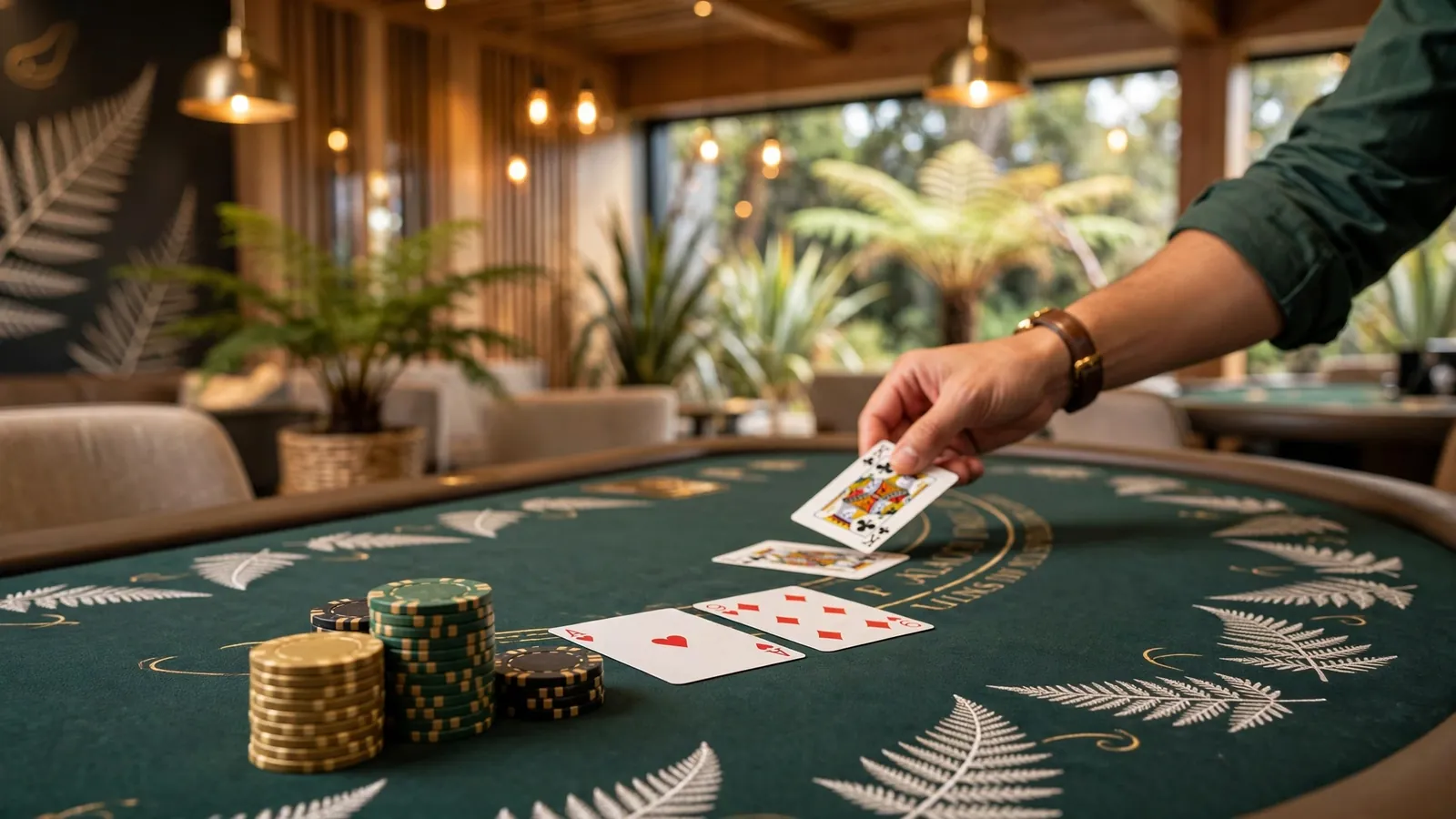
Table of Contents
- The Deal: Values, Turns and the Dealer
- Free Online Blackjack, Without the Table
- A No-Stakes Hand, and What It Can Teach
- Online Casino Play in New Zealand’s 2026 Transition
- Strategy Begins with the Rules on the Table
- Other Players, Card Counting and the Online Deal
- Blackjack as a Game, Not a Guaranteed Win
- Choosing an Action as the Hand Develops
- A Beginner’s First Hand: What the Cards Mean
- Two Hands, One Decision at a Time
The Deal: Values, Turns and the Dealer
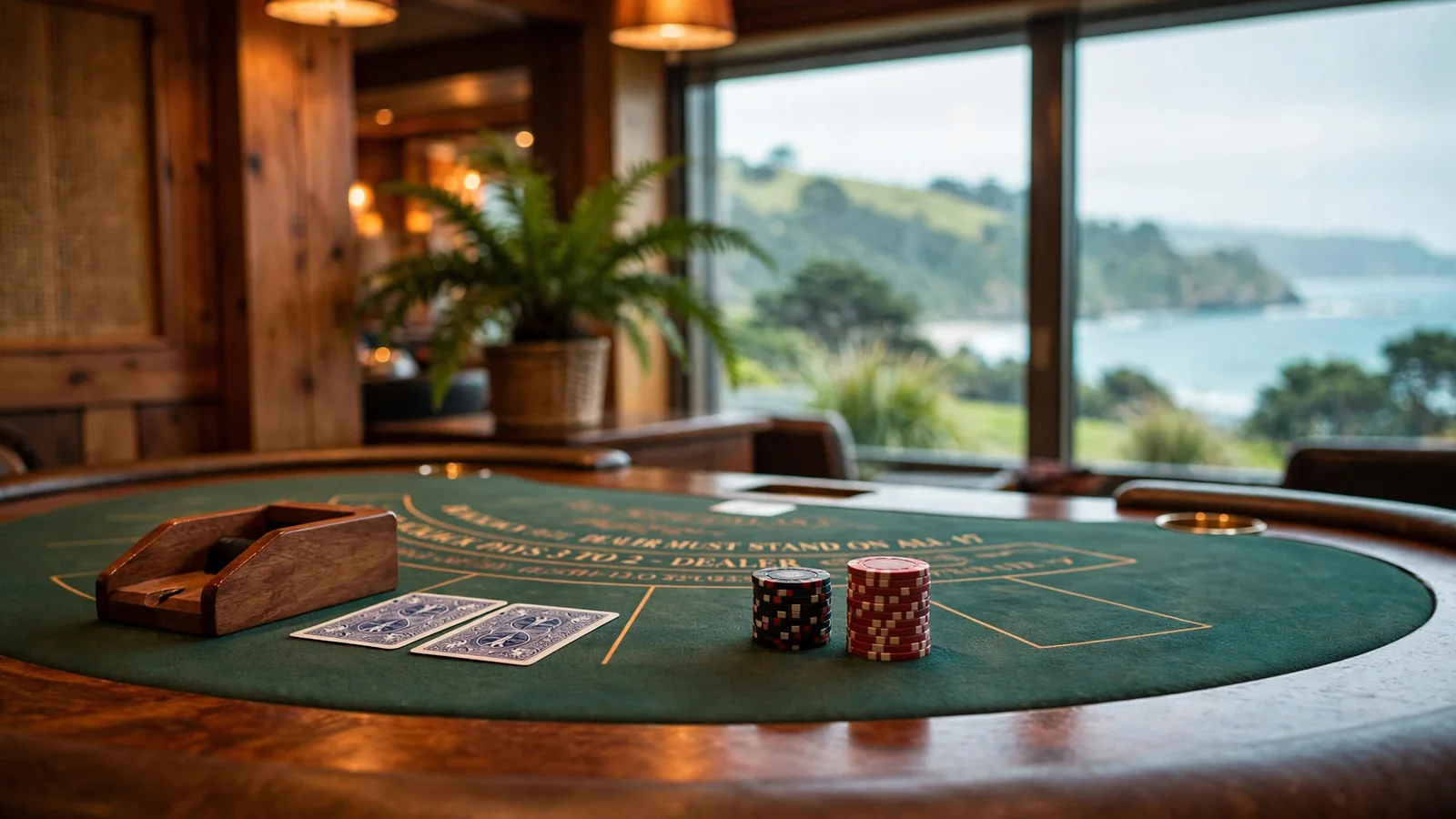
Blackjack is a contest against the dealer, not a competition among the people seated around the table. The aim is to finish with a hand nearer to 21 than the dealer’s, without going over. That last condition matters: a hand that exceeds 21 is bust, and being closer than the dealer cannot rescue it. The game’s tension comes from trying to improve a total while knowing that another card can carry it past the limit.
The arithmetic is deliberately plain. Number cards count as the numbers printed on them; jacks, queens and kings each count as 10. An ace has a more accommodating value: it can count as 1 or 11, whichever keeps the hand more useful without making it bust. A hand with an ace counted as 11 is often called soft, because the ace can be treated as 1 if a later card changes the total. Without an ace playing that flexible role, the hand is hard.
That small act of adjustment gives the ace much of blackjack’s character. A total is not always a fixed sum in the way a row of coins is fixed. The same cards can produce a different working total depending on what the player draws next. The numbers are simple; their consequences are not.

The opening hand
Once the cards are dealt, the player considers the total and the dealer’s position at the table. The player’s turn is a choice about whether to take another card or keep the hand as it stands. The dealer also has a hand to complete, but the basic objective remains direct: make a stronger total than the dealer without crossing 21.
A starting hand of an ace and a card worth 10 is a natural blackjack. It is distinct from reaching 21 by drawing additional cards, and the distinction can affect the payout. A specialist review describes natural blackjack as paying 3:2 at some tables and 6:5 at others; those figures should be read as examples of different table terms, not as a promise about any particular game. The felt may look familiar while the small print changes the value of the same hand.
The available actions shape the turn:
- Hit: take another card, adding its value to the hand.
- Stand: take no further card and leave the total unchanged.
- Double down: increase the commitment to the hand and take a restricted next step according to the table’s rules.
- Split: divide an eligible starting pair into separate hands, where the table permits it.
The last two actions change more than the arithmetic. Doubling down makes the decision to continue more consequential; splitting turns one opening hand into two decisions against the dealer. The eligibility and precise procedure are table matters, so the printed rules carry more authority than a memory of how another game worked.
Hitting is not automatically bold, and standing is not automatically cautious. Either can be sensible or poor depending on the hand and the dealer’s position. At the simplest level, the decision is a balance between the risk of busting and the possibility that the dealer will finish closer to 21. Blackjack offers no action that guarantees the better result. The player chooses under uncertainty; the dealer completes the other side of the contest.
A table is a set of terms
The familiar outline of blackjack is not a complete rulebook. The number of decks can differ, as can whether the dealer takes a card or stands on soft 17. Surrender may be available at one table and absent at another, and payouts can also vary. A rules panel is therefore part of the game, not decoration around it. A specialist review notes these differences across games, but the terms shown for the particular table are what govern a hand.
For someone learning how to play blackjack at a casino, the useful sequence is modest: identify the card values, total the hand with the ace counted appropriately, then choose among the actions the table allows. It is unnecessary to make the game mysterious. Nor is it wise to assume that a rule remembered from one table travels intact to the next.
Attention: Set a limit before play and do not chase losses by extending it. Read all wagering requirements and maximum-bet rules before committing money.
Playing for money adds consequence, not a different arithmetic. A total remains a total, but decisions now affect a real budget. Set a limit before play and do not chase losses by extending it. Where a casino’s wagering requirements apply, blackjack may contribute differently from other games, and maximum-bet rules may apply during wagering; the relevant conditions should be read before money is committed. Fine print has a long life.
The phrase “blackjack 21” makes the destination sound simple, and in one sense it is: finish nearer to 21 than the dealer, without going over. But the game is less a race toward the highest possible total than a sequence of choices made with incomplete certainty. Each hit changes the hand; each stand leaves it exposed to the dealer’s result. The dealer is not an opponent with a personality, though the table can make the contest feel personal. Just arithmetic, and nerves.
Free Online Blackjack, Without the Table
The familiar green felt is optional. Blackjack played through a screen can be generated by software or dealt by a live dealer using physical cards. Both formats put the same contest on display, but the experience behind the image is quite different: one is a quick exchange with a program, the other a streamed table whose pace belongs partly to the people and equipment in the room.
An online game using a random number generator, or RNG, shuffles the cards through software. There is no camera showing a dealer handling a physical deck. The cards appear on screen as the game runs, and the next hand can begin without waiting for a human dealer to gather cards and prepare the table. That makes RNG blackjack faster than a live-dealer game. It is the digital equivalent of a table stripped of its ceremony.
The software handles the deal; the player interacts through buttons and menus. The visual style may imitate a casino table, or keep the design spare, but the essential distinction is not the artwork. It is that the cards are produced by the game’s software rather than drawn from the cards visible in a streamed room. A virtual felt surface can look reassuringly tangible. It remains a screen.
Free online play may be offered as a mode within a game, rather than as a separate kind of blackjack. Where that option is available, it allows the interface and pace to be explored without making a real-money wager. The word “free” describes the terms of that session, not how the cards are dealt: an RNG game can have a free mode, and the RNG itself does not mean every version is free. The format and the stakes are separate questions.
That distinction matters for people who want to play blackjack online without downloading software. A game may run in a browser, but whether it offers free access, and whether it needs an app or account, depends on the particular service. A browser-based game is not automatically a no-cost game; nor does a free mode tell anything about the method of dealing. The screen can hide several different arrangements beneath a similar-looking table.
Software-generated deals using a random number generator. It is faster and stripped of ceremony.
Physical cards dealt by a human and streamed via camera. It retains the pace and ritual of a real table.
Live-dealer blackjack keeps the physical cards in view. A dealer handles and deals actual cards at a real table, while a camera streams the action to players watching remotely. In that respect, the game resembles sitting at a casino table: the source of the cards is visible, and the dealer’s movements form part of the experience. The screen does not replace the table so much as place it at a distance.
Distance has consequences. Streaming can introduce delays, so the action may not move as briskly as it does in an RNG game. The feed has to show the table, and the round depends on a live dealer rather than software that can produce the next hand immediately. Live tables may also require higher bets. These are structural differences, not promises of a more authentic or more advantageous game. A camera makes a physical table visible; it does not make the remote experience identical to being there.
The choice between formats is therefore a choice about what the screen is doing. In RNG blackjack, software creates the deal and supports a quicker rhythm. In live-dealer blackjack, cameras transmit a physical game, with the human pace and possible streaming lag that entails. Neither description says whether a particular session is free. That depends on how the game is offered.
The two formats can also make the same game feel socially different. A software table is often a largely private exchange between player and interface. A live stream foregrounds the dealer and the room, even though the viewer remains elsewhere. One removes much of the visible ritual; the other sends it through a camera. The old table survives, but as an image with a connection between it and the player.
For a free session, the useful detail is not simply that no real-money wager is involved. It is also whether the game is software-dealt or streamed from a live table, because that determines the pace and the kind of interaction on offer. A free RNG session can move quickly; a live stream retains the pauses and delays of a broadcast table. A free label does not settle every condition, so the terms displayed for that mode still matter.
When a session involves real money, the distinction between free and paid play should be especially clear. The game’s presentation may remain unchanged while the terms do not. Fine print and bonus conditions can affect how a real-money offer works, and blackjack may count differently toward wagering requirements; maximum-bet rules can apply during wagering. The digital table is often neat about its graphics. Its terms deserve the same attention.
A No-Stakes Hand, and What It Can Teach
A free hand of blackjack is a small rehearsal without a wager attached. Its value is not that it predicts what will happen at a casino table; it is that it lets the sequence of decisions become familiar while the consequence of a mistake remains confined to the game. That distinction changes the mood. A player can pause, reconsider, and see how a choice unfolds without turning the result into a loss of money.
Free play allows a player to pause and reconsider decisions without the financial consequence of a mistake.
Free play can also be play for its own sake. The cards, the rhythm of a hand and the mild suspense of waiting for the dealer’s outcome are enough to make a game engaging. Sound may add to that atmosphere when a version includes it, though silence can be part of the appeal: blackjack does not require a soundtrack to make uncertainty audible.
The useful lesson is modest. Practice can make the shape of a decision less unfamiliar. It cannot establish that a particular choice will win, or that a run of favourable results will continue. A simulated hand gives a result inside a game; it does not offer a forecast of the next session. Chance remains stubbornly uninterested in rehearsal.
That makes free blackjack well suited to experimenting with attention. A player might notice whether a decision feels obvious before the result, or only after it. The difference matters. Outcomes invite hindsight: once the dealer’s cards are visible, a choice can seem inevitable, even though it was made under uncertainty. A no-stakes session makes it easier to separate the decision from the emotional weight of its ending.
It can also reveal habits. Some people act quickly to keep the game moving; others hesitate over every turn. Some treat a bad result as a reason to change course, even when the rules have not changed. Free play offers a place to notice these reactions without giving them a financial cost. It is less a miniature casino than a mirror with cards.
There is a social history tucked into that quiet exercise. Games of chance have long offered a structured way to spend time together: rules make the encounter legible, while uncertainty supplies the conversation. Digital play can preserve the structure while removing the table’s physical company. A sound effect may imitate the room; it cannot supply the other people in it. For some, that is a loss. For others, the uncomplicated privacy is precisely the attraction.
A version that runs without a download may suit someone who wants a brief diversion rather than a permanent app, but the important point is not the delivery method. It is the difference between practising in a no-stakes setting and wagering real money. Free play can be casual, interrupted, or abandoned without having to justify the time spent. Recreation is allowed to be only recreation.
The limits matter because blackjack is not one unchanging set of conditions. Variants can alter the rules, and those differences can change both the strategy a hand calls for and the house edge. Familiarity gained in one version may not transfer neatly to another. A player who has learned a rhythm in one game may encounter different conditions elsewhere; the table’s details, not the comforting repetition, determine what applies.
For that reason, free play is best understood as orientation, not certification. It can help make the flow of a game recognisable and expose the personal habits that arise around uncertainty. It cannot erase differences between variants or turn chance into a skill test with a guaranteed grade. No stakes, no prophecy.
If a casual session ever gives way to real-money play, the change is not merely a more vivid version of the same entertainment. Money changes the pressure around every result. A set budget and a willingness to stop rather than chase losses keep that distinction visible. Free blackjack needs no such arithmetic; it can simply be a way to pass an evening, listen to a few imagined cards land, and leave the table untouched.
Online Casino Play in New Zealand’s 2026 Transition
Choosing where to play blackjack online in New Zealand is easier when you check the details that are actually available about each operator. Use these short verdicts as a starting point when considering your options.
Payout speed: 1-3 business days Wintino lists a payout speed of 1–3 business days.
License: Curaçao Gaming Authority, licence no. OGL/2024/165/0185 BitStarz lists a Curaçao Gaming Authority licence, number OGL/2024/165/0185.
License: Malta Gaming Authority, licence no. MGA/B2C/370/2017 Play Grand lists a Malta Gaming Authority licence, number MGA/B2C/370/2017.
License: Tobique Gaming Commission, licence no. 0000091 7Bit Casino lists a Tobique Gaming Commission licence, number 0000091.
License: Tobique Gaming Commission, licence no. 0000064 Neospin lists a Tobique Gaming Commission licence, number 0000064.
License: Tobique Gaming Commission, licence no. 0000002 Ricky Casino lists a Tobique Gaming Commission licence, number 0000002.
License: 07017519840 · Payout speed: 1-3 business days Zotabet lists licence number 07017519840 and a payout speed of 1–3 business days.
Payout speed: 1-3 business days Lamabet lists a payout speed of 1–3 business days.
License: Malta Gaming Authority, licence no. MGA/B2C/394/2017 N1 Casino lists a Malta Gaming Authority licence, number MGA/B2C/394/2017.
For anyone considering online blackjack in New Zealand, 2026 is not an ordinary year in the market. The Online Casino Gambling Act 2026 created the country’s first domestic licensing system for online casino gambling, but its arrival does not mean the full system is already operating. The Act took effect on 1 May 2026, beginning a transitional period that runs until 1 December 2026.
That transition has a defined boundary. Online casinos that were already providing services to people in New Zealand before the Act began may continue operating until 1 December, subject to the Act’s transitional provisions. The allowance is not a general invitation for new providers to enter. Nor does it amount to a completed licensing regime: the fully licensed system is not expected to be operational until 2027.
The Department of Internal Affairs (DIA) is New Zealand’s primary gambling regulator and oversees the online casino licensing framework. The Gambling Commission has a different, more specific task: it hears and decides casino licence applications, issues online casino licences and approves changes to licence conditions. One office oversees the framework; the other makes licensing decisions. Regulatory prose has its own division of labour.
This distinction matters when questions arise about where to play live blackjack online, or which website might be best. During the transition, a provider’s continued operation does not, by itself, mean that it already holds a licence under the new system. A licensing framework being established and a licence already issued are not the same thing. The law’s staged approach asks for patience from the market, a quality rarely celebrated in casino advertising.
The legal setting also has a history. Under the Gambling Act 2003, online casinos could not be based in New Zealand. Before the 2026 Act, online casino gambling supplied from outside the country was not licensed or supervised by a New Zealand regulator. Customers who wagered with offshore websites during that period had no domestic government recourse. The new Act changes the framework, but does not erase that earlier gap.
The transitional period also carries restrictions for providers. Advertising by online casino operators to people in New Zealand is prohibited during this phase. Providers that have not applied for a licence must stop conducting online casino gambling in the country by 1 December 2026. If an application is declined, the provider must cease its online casino operations in New Zealand and leave the market. Unlicensed operation is expected to become an offence from around mid-2027.
That context is more useful than treating a casino bonus or professional blackjack tips as questions detached from the rules governing the market. A bonus does not establish a provider’s licensing position, and an application is not the same as an approved licence. Once the full regime is in operation, licensed operators will face tighter age and identity checks; advertising will be permitted only within strict rules, while sponsorships are prohibited.
Legal Restrictions
Advertising by online casino operators to people in New Zealand is prohibited during the transitional period ending 1 December 2026.
The transition is a change in public oversight, not a guarantee of any particular outcome at the table. Its central question is institutional: who may provide online casino gambling, under what authority, and with which regulator responsible for the decision. In New Zealand, those answers are being put into law in stages.
Strategy Begins with the Rules on the Table
A blackjack strategy is not a set of instructions floating free of the table. It is a response to a particular arrangement of rules. The same hand can call for a different decision when the dealer’s obligations, the number of decks or the terms for a natural blackjack change. Advice that omits those conditions may sound crisp, but its precision is borrowed.
A specialist review notes that tables can differ over the number of decks, whether the dealer takes a card on soft 17, surrender, and the payout for a natural blackjack. Those details are not decoration. They shape the choices available and the value of a hand against the dealer’s likely outcome. The review is a description of possible rule differences, not evidence that any one set of terms is standard across New Zealand tables.
Variants matter for the same reason. A familiar label does not guarantee identical play: a version may alter a rule that changes which decisions are favourable. That can affect the house edge, the mathematical advantage held by the game over time. The direction and size of the effect depend on the rules in combination; no single adjustment can be assessed in isolation.
That is where the search for the best way to play becomes less like learning a recipe and more like reading a contract. A strategy chart or piece of advice only fits if its assumptions match the table. Before relying on one, the relevant terms need to be clear: how many decks are used, how the dealer treats soft 17, what happens when surrender is permitted, and what the table pays for a natural. Without that comparison, two players may appear to be discussing the same game while working from different premises.
The point is not that every variation demands a wholly new system. It is that strategy has boundaries. Advice prepared for one configuration cannot simply be carried over to another and treated as exact. Even a small change in a rule can alter the calculation behind a decision, while several differences together can make a familiar recommendation less dependable.
The house edge is therefore not a fixed property of the word blackjack. It belongs to the game as actually offered, with its particular rules. A table’s printed terms and the strategy being considered should be read together; otherwise, confident advice may describe a game that is not being played.
Rules first. Then strategy.
Other Players, Card Counting and the Online Deal
Blackjack can feel social without turning into a contest between the people at the table. The central opponent remains the dealer; other players make their own decisions alongside that contest. In a live-dealer game, their presence is visible, while an online table may make the shared setting feel more or less immediate. Playing with another person therefore describes a social arrangement, not a different aim or a guarantee that both players act as a team.
The distinction matters because the cards are not a common hand. Each player makes decisions for their own position, even when several people are gathered around the same dealer. Online, the format shapes that sense of company: a live-dealer table shows actual cards and other participants, while an RNG game deals through software and moves at a faster pace. A quicker sequence can make a game feel solitary, even when the screen gives it the furniture of a table.
Card counting belongs to a different question. In its basic form, it means mentally keeping track of cards that have appeared and using that information when judging what may remain. Under New Zealand law, doing this through mental calculation is not illegal. That fact concerns the method; it does not establish that counting will produce an advantage in every game, or that an online interface supplies the conditions needed for it.
Software-shuffled blackjack changes the setting. The cards are generated and shuffled by software rather than dealt from a visible physical shoe, and the pace can leave little of the slow, shared observation associated with a casino table. A counting tool or an app may make calculations, but its presence alone says nothing about whether those calculations correspond to the game’s shuffle or improve a player’s position. Treating software as a shortcut to knowledge of the next deal is a leap, not a strategy.
Live dealing offers a different kind of visibility: actual cards are on the table, and the sequence can be watched. Even there, mental counting is not a promise of success. It is a way of interpreting observed cards, not a system that controls what comes next. The distinction between seeing a deal and predicting it is easy to blur on a screen.
The social question and the counting question thus meet at the table, but do not answer one another. More company does not make a count reliable; fewer faces do not make software transparent. A quiet interface is still a game of chance.
Blackjack as a Game, Not a Guaranteed Win
Blackjack is a contest between each player and the dealer, not a race to collect the most cards or outscore the other people at the table. The aim is to finish nearer to 21 than the dealer without going over. That simple shape gives the game its tension: every decision is made against a target that is visible only in part until the hand resolves.
The dealer is both opponent and representative of the house. The arrangement can make blackjack feel personal—the dealer’s hand sits opposite each player’s—but the contest remains individual. A player may finish ahead of the dealer while another does not. There is no shared team victory, and a table full of confident company cannot turn an uncertain hand into a sure result.
That distinction matters in any version of the game, from a physical table to a digital one. The surface changes; the central contest does not. Blackjack play is about comparing outcomes with the dealer, with 21 as the ceiling rather than a score to exceed. Going past it ends the contest for that hand, even if the dealer later fares worse. The rule is severe in the quiet way of arithmetic.
A game may therefore be won or lost without anyone having made a dramatic mistake. The dealer’s result, the player’s own total and the boundary at 21 all meet in the final comparison. Skill belongs in making choices with the information available; it does not abolish chance or promise a winning session. No system can make that promise honestly.
For someone arriving through a casual game platform or looking to play blackjack as a standalone game, the useful starting point is this narrow definition: one hand against the dealer, judged by closeness to 21 and the risk of exceeding it. The rest—the pace, the setting, the decisions—adds texture to that contest, not certainty. A compact game. An uncertain result.
Choosing an Action as the Hand Develops
A blackjack hand is not a single decision but a small sequence of them. After the deal, the player’s next move depends on the cards already held and on which actions the table permits. The choices may include taking another card, keeping the hand as it stands, increasing the stake through a double down, or splitting a pair into separate hands. Some tables also allow surrender.
Each option changes the shape of the turn. Hitting asks for another card and leaves the hand open to further decisions. Standing ends the player’s turn with the total already held. Doubling down raises the stake while committing the player to a narrower course of play; it is not simply another way to ask for a card. Splitting turns a pair into two hands, each of which must then be played under the table’s rules.
Surrender is the quietest exit. Where available, it lets a player give up the hand rather than continue it. Its presence cannot be assumed: a table may offer it, restrict it or omit it. That detail matters before a hand begins, because an action unavailable at the decision point is no action at all.
The table, then, is more than felt and ceremony. Its rules define the menu. One version of blackjack may permit a choice that another does not, and rules governing doubling, splitting or surrender can change what a player is able to do in the moment. The same cards can therefore meet different practical choices at different tables.
This is why the sequence deserves attention without turning every hand into a puzzle. A decision should be read in context: what the current hand allows, what the table permits and what consequence follows from choosing to continue or stop. No action is a universal escape hatch. Even standing is a decision, not an absence of one.
Before play begins, the posted rules are part of the game itself. They show which moves are available and where the boundaries lie. The cards tell only half the story.
A Beginner’s First Hand: What the Cards Mean
Blackjack becomes easier to read once each card has a value. Number cards count as the number printed on them: a seven adds seven, while a three adds three. Face cards—jacks, queens and kings—each add ten. Their pictures may differ; their arithmetic does not.
Card Value Calculation
Add the numbers on the cards (e.g., 4 and 9) or count face cards (J, Q, K) as 10.
Determine if the Ace should count as 1 or 11 to keep the hand viable without exceeding 21.
Combine the values to reach the final hand total, such as an Ace and a 5 totaling 6 or 16.
The ace is the card that refuses to settle. It can count as one or eleven, with its value understood in relation to the rest of the hand. An ace with a six can make a total of either seven or seventeen. If counting it as eleven would take the hand over twenty-one, it can count as one instead. The same card can therefore offer room to grow or become a modest one.
That flexibility gives the ace a particular place in blackjack. Most cards bring a fixed contribution; the ace asks what the hand can bear. A beginner need not memorise a catalogue of card combinations to grasp the principle. The task at first is simply to add the fixed values and notice when the ace can be counted either way.
A few small examples make the arithmetic plain. A four and a nine total thirteen. A queen and a two total twelve. An ace and a five can total six or sixteen. These are not different kinds of cards or special exceptions: they are the ordinary values of the cards being combined.
That is the basic vocabulary needed to follow a first hand. The deck supplies the symbols; the values turn them into a running total. There is no secret meaning in a face card, and the ace’s double value is not a bonus that can be claimed at will. It is a way of counting the same card according to what keeps the hand viable.
The word “blackjack” can make the game sound like a test of nerve. At the beginning, it is closer to a small exercise in addition, with one unusually accommodating card. Once those values are familiar, the rest of the table becomes easier to understand. The arithmetic comes first.
Two Hands, One Decision at a Time
A blackjack simulator can make the game’s choices easier to consider without turning them into a spectacle. Its useful subject is the decision itself: whether to take another card, keep the hand as it stands, double down, or split when the table permits it. The software may present those choices in different ways, so no particular layout or feature should be assumed. The point is to follow what each action does to the hand.
The question of playing two hands at once changes the pace, not the basic vocabulary. Each hand has its own decision. A hit on one does not answer what should happen to the other; standing on one does not settle the second. Two hands therefore create parallel judgments, not a shared fate. The dealer remains the opponent, but attention has to move between separate totals and separate choices.
Splitting is different. It begins with a pair and divides it into separate hands, each then requiring its own decisions. The action can make a single starting position more complicated, not less. Doubling down also changes the shape of a hand: rather than simply continuing in the same way, the player commits to a different course. The exact conditions for these actions depend on the table, so a simulator’s display should not be mistaken for a universal rulebook.
A useful practice session need not imitate a full casino visit. It can be enough to pause at each decision and notice why one hand calls for a hit while another is left standing. When two hands are in play, that pause matters twice. Blackjack is often presented as a contest of nerve, though much of it is bookkeeping with a pulse.
A simulator is not a forecast of winnings. It can help make choices legible, but it cannot turn a decision into a guarantee. For real-money play, the sensible boundary is a budget set in advance, with losses left where they fall rather than chased into another hand. Check the fine print and bonus conditions before wagering, too; blackjack may count differently towards wagering requirements, and maximum-bet rules can apply while those conditions are active.
Does blackjack always pay 3:2?
No. A natural blackjack may pay 3:2 or 6:5, depending on the table’s rules.
What is card counting?
Card counting is using mental calculation to keep track of cards in blackjack.
Is card counting illegal?
No. Using mental calculation to count cards is not illegal under New Zealand law.
Created by the ”Casino Slots Hub NZ” editorial team.