Live Blackjack in New Zealand: Rules and Play
 Available in US
A practical look at dealer decisions, table variations, free play and the fine print that shapes online blackjack.
Table of Contents
- The Table, the Dealer and the Rules That Vary
- Live Blackjack in New Zealand’s Changing Licensing Landscape
- Live Blackjack Beside the Software-Shuffled Game
- Free Play and the Question of What It Can Teach
- Playing Live Blackjack Online Without Confusing Pace with Skill
- A Blackjack App Is Still a Table with Rules
- Bonuses, Bitcoin and the Small Print
- Why a Natural Blackjack May Pay 3:2—or 6:5
- Choosing a Live Game Without a “Best” List
- Card Counting at a Live Online Table
The Table, the Dealer and the Rules That Vary
Blackjack is a contest against the dealer, not a race to collect cards. A hand closer to 21 than the dealer’s wins, provided neither side has gone over. That last condition matters: a total above 21 is a bust, and a hand that looked promising a moment earlier is finished. The game’s appeal rests partly on this narrow boundary. It makes each new card feel consequential, while leaving the player with decisions rather than control.
The arithmetic is deliberately plain. Number cards retain their face values; jacks, queens and kings count as 10. An ace can be worth either 1 or 11, according to which value helps the hand without taking it past 21. A hand containing an ace counted as 11 is commonly called a soft hand, because the ace can fall back to 1 if another card would otherwise make the total bust. The flexibility sounds generous. It is also the reason a dealer’s soft 17 becomes a rule worth checking.
Choosing a live blackjack site in New Zealand means considering the information available about each operator before you play. This reference card highlights the specific details provided for each option.
Payout speed: 1-3 business days Wintino lists a payout speed of 1–3 business days.
License: Curaçao Gaming Authority, licence no. OGL/2024/165/0185 BitStarz lists a Curaçao Gaming Authority licence, number OGL/2024/165/0185.
License: Malta Gaming Authority, licence no. MGA/B2C/370/2017 Play Grand lists a Malta Gaming Authority licence, number MGA/B2C/370/2017.
License: Tobique Gaming Commission, licence no. 0000091 7Bit Casino lists a Tobique Gaming Commission licence, number 0000091.
License: Tobique Gaming Commission, licence no. 0000064 Neospin lists a Tobique Gaming Commission licence, number 0000064.
License: Tobique Gaming Commission, licence no. 0000002 Ricky Casino lists a Tobique Gaming Commission licence, number 0000002.
License: 07017519840 · Payout speed: 1-3 business days Zotabet lists licence number 07017519840 and a payout speed of 1–3 business days.
Payout speed: 1-3 business days Lamabet lists a payout speed of 1–3 business days.
License: Malta Gaming Authority, licence no. MGA/B2C/394/2017 N1 Casino lists a Malta Gaming Authority licence, number MGA/B2C/394/2017.
At the table, the basic choices are to hit, stand, double down or split, with surrender available at some tables. Hitting asks for another card. Standing ends the player’s turn and leaves the existing total to face the dealer’s. Doubling down means increasing the stake in return for taking a further card under the table’s conditions; splitting separates a pair into two hands, again subject to the rules governing that table. Surrender, where offered, lets a player give up a hand rather than continue it. These are not interchangeable gestures. Each changes what remains possible, and each is made against a rule set that should be understood before the cards begin to move.
The dealer is not simply another player with an equal menu of choices. The dealer’s actions are governed by the table rules, which specify how the hand proceeds. One point of variation is soft 17: a dealer may be required to hit it or to stand. Since the ace in a soft hand can count as 1 or 11, the same apparent total can leave room for another card without immediately busting. Whether the dealer takes that card changes the circumstances against which a player’s decisions are judged. A small line of print, with a large shadow.
Decks also differ. A game may use a different number of decks from another, and the rules can therefore not be inferred just from the familiar layout of cards or the word “blackjack” on a table. Surrender may be permitted in one game and absent in another. Payout terms can differ too. A specialist review notes these variations as features of particular tables, rather than as one fixed package that defines every game. That distinction is useful: a description of a blackjack variant is not a promise about all tables carrying the same broad label.
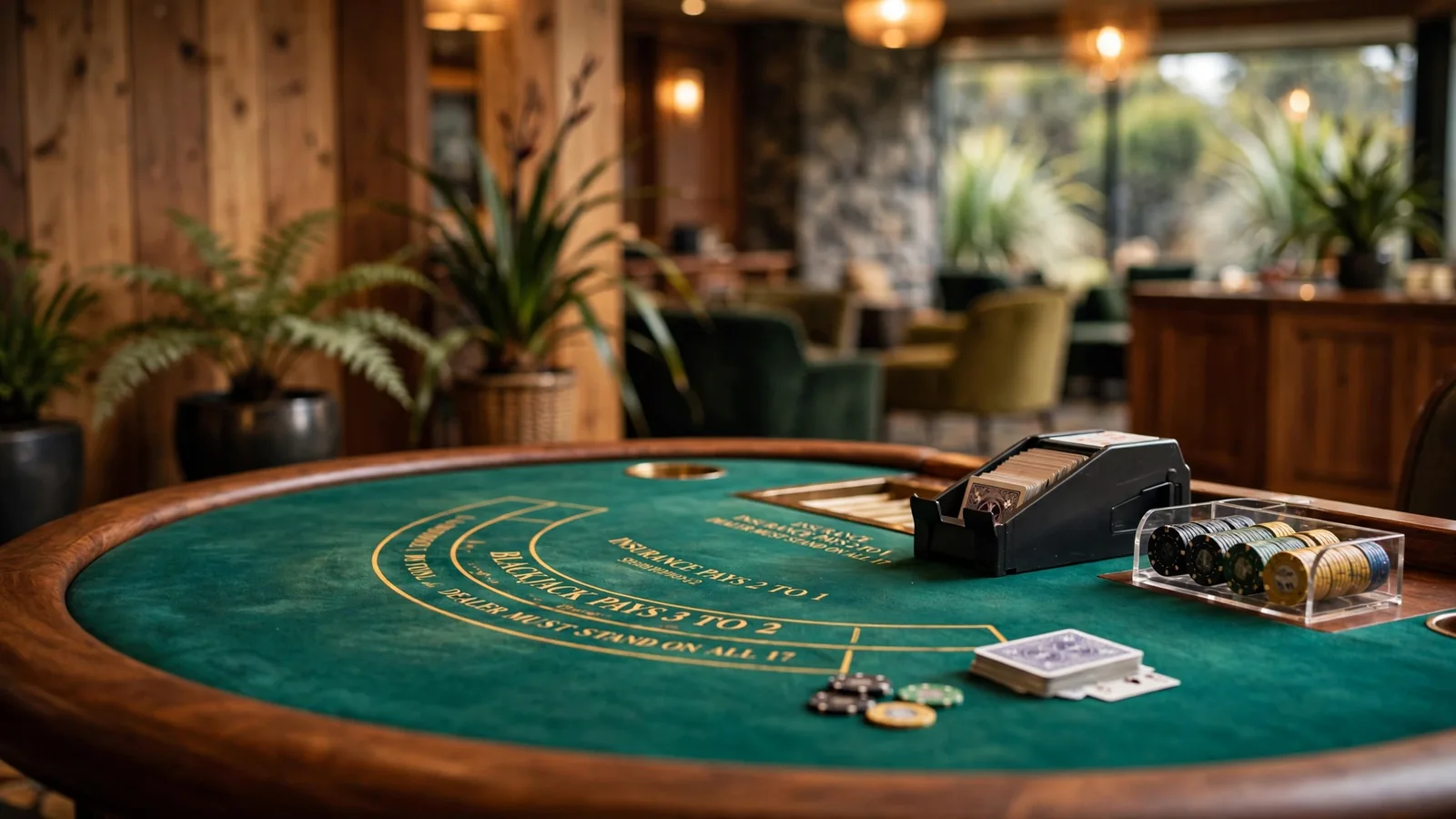
The ordinary sequence can make those differences easy to overlook. Cards are dealt, a player weighs the current total against the possibility of drawing again, and the dealer eventually completes the hand according to the posted rules. Yet the decisions sit inside a structure set before the first card: how many decks are in play, what happens on soft 17, whether surrender is allowed and what a winning natural blackjack pays. A player who knows the basic actions but not these conditions knows how to move a hand, not quite what game is being played.
A natural blackjack refers to an opening hand made from an ace and a card worth 10. Its payout is one of the details that can vary between tables; the precise difference belongs in the rule display, not in assumptions carried over from another game. A table’s felt or interface may make the game feel familiar, but familiarity is not a rule. The posted terms do the work.
This is why “live casino blackjack rules” are not a single universal code. The shared aim and card values make the game recognisable, while the local rules shape the decisions around them. A player may choose to stand, hit, double or split; the consequences depend partly on what the table allows and how the dealer must play. There is no trick that makes those conditions irrelevant. The useful habit is less theatrical: read the rules before treating one table as interchangeable with the next.
Live Blackjack in New Zealand’s Changing Licensing Landscape
Live-dealer blackjack brings a physical table into an online casino. A dealer handles actual cards while a camera sends the hand to players watching remotely. The setup preserves the visible rituals of a casino table, though the screen adds a layer between the deal and the decision: a stream can lag, and a live table may require higher bets than a software game. The cards are real; the setting is mediated.
In New Zealand, that distinction now sits inside a new legal framework. The Online Casino Gambling Act 2026 came into force on 1 May 2026, establishing the country’s first domestic licensing system for online casino gambling. It marks a change from the earlier arrangement, in which online casino services were supplied from outside the country without a New Zealand regulator licensing or supervising them. Customers using offshore websites in that period had no domestic government recourse if a dispute arose. The framework has changed; the transition is still under way.
The Gambling Act 2003 does not permit online casinos to be based in New Zealand, and domestic online casinos remain prohibited. The newer law does not simply turn every online table into a locally licensed one. Instead, it sets up a process for licensing providers, with a transitional period for those already serving people in the country. The Department of Internal Affairs is New Zealand’s primary gambling regulator and oversees the online casino licensing framework. The Gambling Commission has a distinct role: it hears and decides casino licensing applications, issues online casino licences, and approves changes to licence conditions.
That division matters because “regulated” is not a decorative label. The Department oversees the framework; the Commission makes decisions about licences and their conditions. The Online Casino Gambling Act created a route to domestic oversight where none had existed for offshore online casino gambling. But a route is not the same thing as a fully functioning system. The licensed regime is not expected to be fully operational until 2027.
The Act also provides a bridge between the old and new arrangements. Providers that were already offering online casino services to New Zealand customers before 1 May 2026 may continue during the transition, which ends on 1 December 2026. That permission is subject to the Act’s transitional provisions, not an assurance that every provider will qualify for a licence later. Providers that have not applied by the end of the transition must stop conducting online casino gambling in New Zealand. If an application is declined, the provider must cease those operations and leave the market.
So, in 2026, the meaning of live blackjack in New Zealand includes a question beyond the table: which legal stage applies to the service being offered? The transition does not make offshore provision equivalent to a future licensed operation. Nor does the existence of a licensing framework mean that the full regime is already in place. Unlicensed operation is expected to become an offence around mid-2027, while the Act’s transition sets an earlier practical boundary for providers that do not apply.
The regulatory changes also affect how gambling services may be presented. Advertising by licensed operators is permitted only under tight rules, and sponsorships are prohibited. During the transition, advertising to people in New Zealand is prohibited. Licensed operators must also introduce stricter age and identity verification systems. These requirements concern the provider’s obligations, rather than the mechanics of a hand, but they form part of the same shift: online casino gambling is moving from a largely offshore arrangement towards a system with domestic oversight.
Legal Compliance
Providers that have not applied for a licence by 1 December 2026 must stop conducting online casino gambling in New Zealand.
The new regime does not make a live stream a guarantee of local protection. A physical dealer and actual cards describe how the game is delivered, not the legal status of the business transmitting it. During the earlier offshore era, players had no domestic government recourse; under the new framework, domestic licensing is being built through a defined transition. The two ideas should not be collapsed into one. A familiar table on screen is still only a table on screen.
New Zealand’s approach reflects a broader tension in gambling regulation: the law has long resisted casinos being based domestically while people could still reach online services based offshore. The 2026 Act changes the terms by creating a first domestic licensing regime, but it does so in stages rather than by instant substitution. For a live blackjack service, the regulatory context is therefore neither simply “offshore as before” nor “fully licensed now.” It is a market in transition, with a regulator overseeing the framework and a Commission determining who may enter the licensed system.
Live Blackjack Beside the Software-Shuffled Game
The difference between a live table and an RNG game is not merely a change of scenery. One puts a dealer, cards and a camera between the player and the next decision; the other produces the hand through software. Both carry the name blackjack, but they make time feel different.
At a live table, the cards are actual cards. A dealer handles them in a studio or casino setting, while a stream brings the table to the screen. That gives the game a visible human centre: cards are dealt, collected and dealt again, rather than appearing as the output of a software shuffle. For some players, that physical sequence is part of the point. The table has a rhythm that can be watched, not just a result that can be read.
The resemblance to a casino table has a limit, of course. A screen is not the room itself. The stream may lag, so the image and the next stage of play do not always arrive at the pace expected. A pause can belong to the connection rather than the dealer, and waiting for the table to move is one of the less glamorous features of online live play. Still, visible cards and a human dealer make the format feel closer to the old public ritual of the casino: people gathered around a table, watching a small sequence of events acquire importance.
RNG blackjack has no dealer on screen dealing physical cards. The shuffle is handled by software, and the game can move faster than its live counterpart. There is less waiting for a dealer to complete a hand and less time occupied by the stream. The next result arrives through the game interface, in a format designed for a quicker cycle of play.
Speed is not a measure of quality. It is a property of the format, and it changes the experience. A faster game can make each hand feel like one item in an uninterrupted sequence. Live play leaves more room for pauses, though those pauses may come from the stream rather than from any deliberate theatrical flourish. Neither pace says anything by itself about a player’s skill or the value of a particular hand. It says how quickly the setting carries the game forward.
Features actual cards and a human dealer via stream, preserving casino rituals but potentially introducing stream lag.
Uses software shuffles and interfaces for a faster cycle of play without the pauses of a live stream.
There is also a practical difference in what the screen must do. RNG play depends on software to shuffle and present the game. Live play depends on a video connection as well as the table itself. A delay is therefore part of the live format’s possible friction, not evidence that the cards have changed. The visible table can offer a more tangible scene, while the stream adds a layer that a software-shuffled game does not need.
For live blackjack in New Zealand, the choice between these formats is consequently a choice between kinds of presence and pace. Live play shows actual cards and a dealer, but the stream can slow the hand and the game may require higher bets. RNG play gives up the physical table and moves faster. The distinction is plain enough; the preference is personal, shaped by whether the ceremony matters more than the interval between hands.
The contrast also explains why “live” should not be mistaken for “better.” The camera supplies a human performance and physical cards, not a guarantee of a more engaging session or a more favourable result. Software removes the dealer from view and makes the shuffle invisible, but it does not turn the game into a different kind of contest. One format stages the hand; the other compresses it.
A table, or its simulation.
Free Play and the Question of What It Can Teach
A free-play table can make blackjack’s sequence easier to follow. Cards appear, the dealer’s hand develops, and a player chooses how to respond without putting money at stake. That removes one distraction, though not the game’s central tension: blackjack is played against the dealer, and the aim is to finish closer to 21 without going over.
The value lies in rehearsal of attention. A hand asks for a decision while information is incomplete; free play offers a chance to notice that rhythm, see how a choice changes the next moment, and become less distracted by the screen’s movement. The setting may resemble live blackjack, but resemblance is not equivalence. A practice hand can introduce the shape of play, not reproduce what money does to it.
That distinction matters because the same decision can feel different when it carries a cost. In free play, a loss is an event in a sequence. With money involved, it may become a reason to hurry, hesitate, or try to recover what has gone. The table has not changed; the person’s relation to it has. Free practice cannot measure that difference.
Nor does a favourable run establish that a player has mastered blackjack. Outcomes are not a tidy report card on judgement: a good decision can be followed by a poor result, and a careless one can appear vindicated. Free play can help make decisions visible, but it cannot turn chance into evidence of personal skill. The house has no obligation to reward confidence.
There is a quieter lesson in practice, too. It shows how quickly a hand moves from one decision to another, and how easily attention drifts when each moment seems familiar. A player following live blackjack free play may learn to keep track of the current hand and to pause before acting, rather than treating every deal as an invitation to improvise. That is a modest skill, but modesty is useful at a table.
Attention: Free play is a rehearsal for the game’s flow and cannot reproduce the emotional pressure or financial risks of real-money play.
The word “free” can also mislead. It describes the absence of a stake in that session, not the arrival of a dependable method for playing with money. No practice mode can establish what a later session will cost, how it will feel, or whether a player will keep to a budget. Those questions belong to real-money play, where limits matter and chasing losses can turn a pastime into something less manageable.
Free play is therefore best understood as a small rehearsal, not a promise or a verdict. It can make the flow of a hand less strange and reveal whether the format is understandable. It cannot guarantee sound choices under pressure, predict results, or make paid play risk-free. A useful distinction. Live blackjack free online may offer a way to watch decisions unfold without a stake, but the lesson ends at the edge of that boundary.
Playing Live Blackjack Online Without Confusing Pace with Skill
A live hand has a physical centre: a dealer, actual cards and a table seen through a stream. Online, the player is present by way of a screen, but the decisions still arrive in sequence. A hand turns on whether to hit, stand, double down or split, with the available choices shaped by the situation and the table’s rules. The camera makes the dealing visible; it does not make the decision easier.
That distinction matters because live play can feel more deliberate than it is. A pause while the game catches up may give a choice more gravity, but waiting is not analysis. Streaming can delay the action, and that gap belongs to the format, not to the player’s judgment. Conversely, a hand may move briskly once the choice is made. Speed and skill are separate things, though the screen can make them look like one.
The player is not controlling the cards. The dealer handles them, while the online participant chooses how to respond to the hand in front of them. Hit, and another card enters the decision. Stand, and the hand is left as it is. Doubling down or splitting changes the shape of the play, where the rules allow it. These choices can be consequential without being evidence of mastery. A sound decision can still end badly; a careless one can be rewarded by chance. The table offers no tidy moral accounting.
Live play also carries the ordinary friction of a remote connection. A stream may lag just as a decision is due, so the pace experienced at home may not match the pace of the physical table. Higher bets may be required at some live tables, another practical difference that can matter more than the atmosphere. Neither a polished view of the dealer nor a sense of being “at the table” changes the underlying uncertainty.
There is a small social theatre to the format, even when the player is alone in a room. The dealer’s movements give the hand a human rhythm; the cards arrive as objects rather than as an abstract result produced by software. That can make each choice feel weightier. It can also encourage the mistaken idea that a vivid experience is a more controllable one. A real deck is not a promise of a better outcome.
The phrase best live blackjack online suggests a single answer, but a table’s appeal depends on more than its presentation. Rules, pace, stream stability and the level of the bets all shape the experience. No one of those qualities turns a hand into a dependable source of skill or income. The spectacle is genuine. So is the uncertainty.
- Set a budget before the first hand
- Treat each decision as independent
- Chase losses after a poor run
- Mistake a delayed stream for a strategic pause
A sensible approach begins before the first hand: set a budget and do not chase losses. A delayed stream or a run of poor results can tempt a player to treat the next decision as a chance to recover. It is still just the next decision, made under the same rules and the same uncertainty. The screen can make the table feel close. It cannot make fortune answerable.
A Blackjack App Is Still a Table with Rules
A phone can make a casino table feel pocket-sized, but it does not turn the table into a different game. In live blackjack, a dealer handles actual cards while a camera carries the action to the screen. The app is the viewing and control layer; the game still unfolds around a physical table, with its own rules and pace.
That distinction matters when comparing live blackjack apps. A polished screen may make the controls easier to read, but it cannot change how the dealer runs a hand or what the table permits. The relevant details remain the ones attached to the game itself: its rules, the available decisions and the terms displayed before play. Familiar graphics are not evidence of identical conditions.
A live stream can also arrive with a delay. The action seen on a phone may not feel as immediate as sitting beside the dealer, and a pause can be part of transmission rather than a change in the hand. That is a practical difference, not a test of skill. The app’s interface may be smooth while the stream still has to travel.
There is a more tangible consideration: live tables may require higher bets than a player expects from the small screen. The device makes the game portable; it does not necessarily make the stake smaller. A sensible budget set in advance helps keep the pace and the interface from nudging a session beyond its intended scale. Chasing losses turns a quick decision into a costly one.
The idea of the best live blackjack app is therefore less about a decorative ranking than about fit. Clear presentation, legible table information and controls that do not obscure the action are useful qualities, but they cannot substitute for checking the particular table’s rules and minimum stake. Nor does an app remove the need to distinguish the dealer’s live decisions from the player’s own.
The small screen can soften the ceremony of a casino table. The cards remain real, the stream may lag, and the terms remain the terms. A phone changes the setting. Not the bargain.
Bonuses, Bitcoin and the Small Print
A promotion can make a live table look more generous than it is, but the bonus headline is only the entrance to its terms. The important questions sit further down: which games count towards wagering requirements, how blackjack is weighted, and what maximum bet rules apply while a bonus is active. Blackjack may contribute differently from other games, so a balance that appears available for play is not necessarily clearing the promotion at the same rate as every other wager.
Blackjack Weighting
Blackjack may contribute differently towards wagering requirements compared to other games, affecting how quickly a bonus is cleared.
That difference matters particularly at a live table, where the pace and format can make a bonus feel like part of the game rather than a separate contract. It is not. A live blackjack bonus should be judged by its conditions, not by the size of the advertised offer. If the rules restrict a bet while wagering requirements remain, exceeding the stated maximum can affect eligibility. The small print is not decoration.
Bitcoin raises a different set of questions. The phrase “bitcoin for live blackjack” describes a payment preference, not proof that a particular casino accepts it or that a deposit qualifies for a promotion. Payment methods, bonus eligibility and withdrawal conditions should be checked in the operator’s own terms before money is moved. A cryptocurrency label does not settle how a bonus is calculated, or whether funds deposited that way are treated differently.
Promotions also have a way of turning attention from the cost of play towards the apparent value of the offer. That can encourage longer sessions or larger bets than intended. A budget set before play gives the session a boundary; chasing losses after that boundary is reached only makes the promotion more persuasive, not more valuable.
Trustworthy terms should make clear how blackjack counts towards wagering requirements and which maximum bet rules apply during wagering. If those points are unclear, the offer cannot be assessed with confidence. Nor should a bonus be treated as evidence that a table has favourable rules or that a player is more likely to win. It changes the conditions around the money, not the cards.
Read the conditions before accepting an offer, and keep the payment decision separate from the game decision. Bitcoin may be a preferred way to move funds; a bonus may appear to stretch a balance. Neither removes the need to understand what happens to that balance once wagering begins. The headline is the easy part.
Why a Natural Blackjack May Pay 3:2—or 6:5
A natural blackjack is the opening combination of an ace and a ten-value card. It is distinct from reaching the same total after taking another card: the two-card hand may qualify for a special payout, while a later total of 21 does not. The distinction turns on how the hand was made, not simply where it ends.
A specialist review reports that natural blackjacks may pay at either 3:2 or 6:5, depending on the table. These ratios describe winnings relative to the original stake; the stake itself is returned as well. At 3:2, the profit is one and a half times the stake. At 6:5, it is one and one-fifth. The gap can look small in a single hand, but it changes the return whenever a natural occurs. Across repeated hands, the lower payout gives more of the advantage to the house.
That is why the payout deserves attention before a hand begins. A live table may show real cards and a dealer, but the familiar appearance does not settle the rules. The payout is part of the table’s terms, alongside details such as the number of decks, the dealer’s action on soft 17 and whether surrender is allowed. A separate specialist review notes that these conditions can differ between games; there is no single rule sheet that applies to every table.
The ratios are easy to read and easy to overlook. A player focused on the ceremony of the deal—the cards turning, the pause before the dealer checks a hand—may miss that the same natural has been assigned a different price. The table’s displayed rules matter more than its familiar name. “Blackjack” is not a complete contract.
Natural Payouts
Example: 3:2 payout on a $10 stake = $15 profit (plus $10 stake returned).
The 3:2 figure is therefore not a promise about every live game, nor should 6:5 be treated as a universal alternative. They are payout terms to compare at the individual table. A game can retain the usual shape of blackjack while changing what a natural earns; that change affects the house edge and the value of the opening hand.
The arithmetic is plain. The custom is not.
Choosing a Live Game Without a “Best” List
A claim that one live blackjack game is the best online choice sounds decisive, but the label cannot mean much without the table’s rules. Blackjack variants are not interchangeable: their rules can change both the decisions available to players and the house edge. A ranking that leaves those differences out turns a judgment into decoration.
The useful comparison is therefore not a polished title or a confident verdict, but the rules attached to the game. A player deciding between tables needs to know what version is being dealt and how its conditions shape play. A rule change may call for a different strategy; it may also alter the house edge. The effect depends on the particular rules, so there is no sound basis for treating every variation as equally favourable or for declaring a universal winner.
This is less tidy than a numbered list. It is also more honest. “Best” can describe a game only in relation to what matters to the person playing it, and a rule set that suits one approach may not suit another. Without a clear account of those rules, a ranking offers no reliable way to distinguish one table from the next.
That matters especially in live blackjack, where the familiar sight of cards and a dealer can make different games appear more alike than they are. The setting is visible; the consequences of the rules are less so. A comparison grounded in those consequences gives a better basis for judgment than a superlative attached to a game name.
The sensible question is not which table has the grandest claim, but what its rules mean for strategy and house edge. Those details do the work. The label does not.
Card Counting at a Live Online Table
In New Zealand, mentally keeping track of cards is not illegal. That answers a question about law, not one about whether the method can produce an advantage. The distinction matters: a permitted calculation is not automatically a useful one, and a live stream is not a private window into the dealer’s shoe.
Card counting works from information accumulated as cards appear. At a live online table, actual cards are dealt and shown on screen, so the game has a visible sequence rather than a software-generated result appearing without physical cards. But visibility alone says little about whether a count can be maintained usefully. The format, the way cards are handled, the pace of play and the delay in a stream all shape what can be observed and when. A sequence that looks continuous on screen is not, by itself, proof that it offers a practical edge.
The distinction is sharper with online RNG blackjack. Those games use software shuffles, and they move more quickly than live-dealer tables. Their results do not supply the same basis for following a continuing sequence of exposed physical cards. Treating each software hand as another page in a count would confuse the appearance of a card game with the conditions a counting method needs.
Even at a live table, mental arithmetic does not alter the rules or make outcomes certain. Counting is an attempt to interpret cards already seen, not a system that guarantees a win. Nor does legality settle the terms under which a particular casino allows play; those are separate questions.
The appeal is understandable. Blackjack has always invited players to look for order in a game built around chance, and the visible dealing makes that impulse especially strong online. Yet the law’s tolerance and the method’s usefulness remain different matters. A stream can show cards. It cannot promise an edge.
Created by the ”Casino Slots Hub NZ” editorial team.